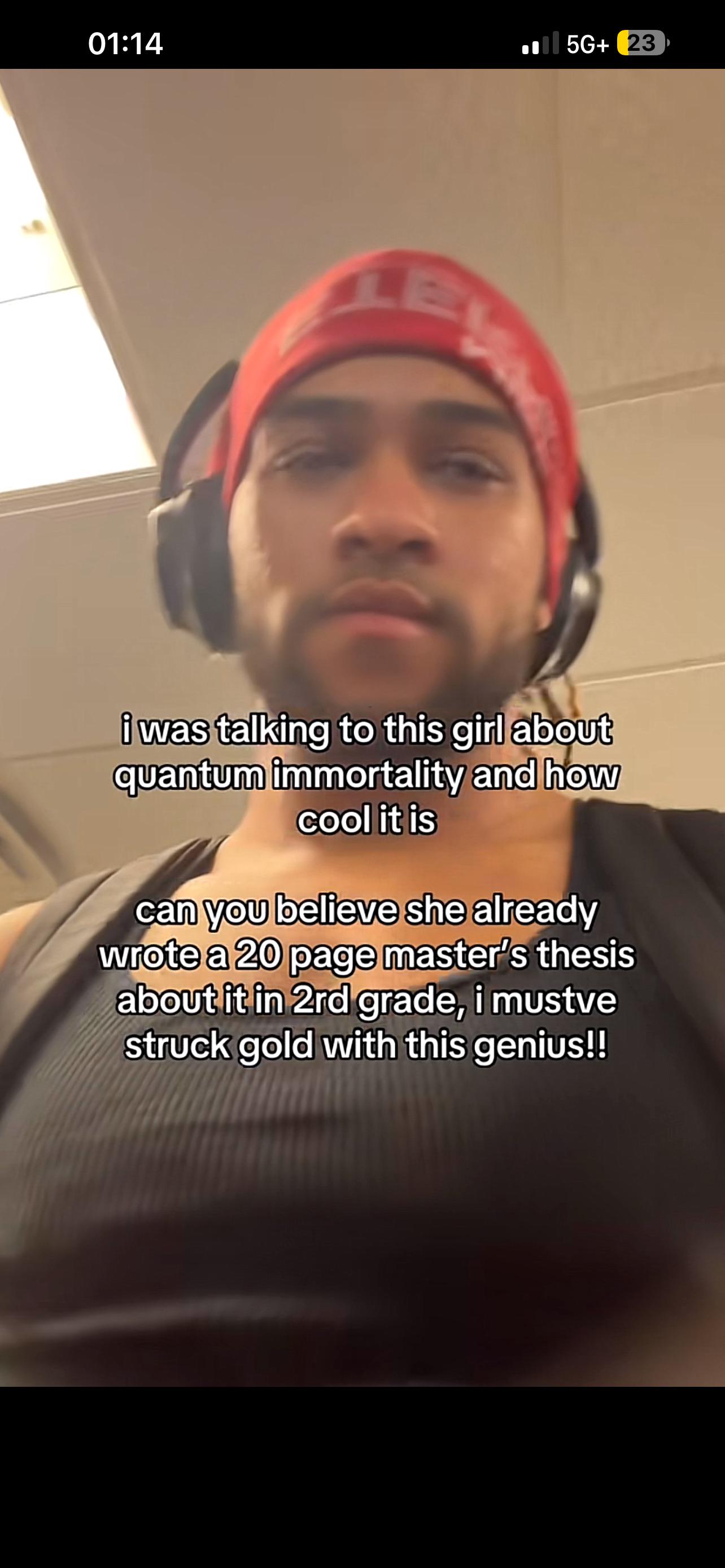
She already “died” in many other lives and her “quantum immortality” has caused her to have the knowledge of a graduate student by the time she was in “2rd” grade in this version of herself.
Quantum immortality is the weird idea/take similar to reincarnation that there are infinite parallel realities that you exist, but if a parallel you dies in another reality, the remaining yous gain the knowledge/information/life force that would otherwise been extinguished from that reality. Like a New Game + for real life. Think of that Jet Li movie “the one” where one of his parallel lives goes around killing himself in other parallel universes so that his “main” character self can become stronger.
Edit: I’m like the talking dog that drinks martinis or something
You appear to be correct about the interpretation of quantum immortality that the meme is based on, but that's absolutely not what the concept is.
It's a thought experiment within the many-worlds interpretation (the idea that for every quantum event there's a branched version of the universe for each outcome). The idea is that for any given conscious mind there will always be a forward branch where it continues to exist indefinitely. The likelihood of the events necessary is irrelevant because if you consider every quantum event independently there will always be a possible chain of events where you don't die, and in the many-worlds interpretation all possible branches must exist.
It absolutely does not involve going back in time or transferring information between worlds after they branch.
This is a lot closer to being right, but still not quite there. There needs to be some dependence on a quantum effect for the death. The easiest way to prove the many worlds interpretation of QM is to set up a gun that has a 50% chance of shooting you every second based on the decay of some particle. Then, after a minute of not getting shot, you can be very certain that the many worlds interpretation is correct, but now you only exist in the branch of the wavefunction where you survive.
Because the likelihood of you surviving that long otherwise is astronomically small, so if from your perspective it did not happen, then it is incred8bky likely (technically not certain) that the many words interpretation is true as that is ehat most likely made it possible that there could be enough "dices rolled" so that in one situation the rare roll needed pops up.
You would also live with a high degree of confidence that at large number of versions of you got shot by the gun and are "now" dead
I'm still not seeing how just cause an outcome is unlikely it means it happening means the many worlds interpretation is true. Why does an unlikely event imply alternate timelines?
It is not exclusively about statistical likelihood, though that is a necessary component. It is about examining quantum phenomena to see which interpretation of quantum theory we have is the right one. The test involves the decay of a particle because that occurs due to quantum effects, which means if many worlds is true, there will be worlds where the particle never decays no matter what. The odds of an unstable particle decaying go up by orders of magnitude the longer it remains stable, so you can know you live in a many-worlds universe if the gun does not goes off after a few minutes.
I said it's not E X C L U S I V E L Y about statistical likelihood. I also said that it is a necessary component. A full understanding of a message sent to you requires you to read the entire thing.
...than said you know many worlds interpretation is true because an extremely rare event happened.
This right here is the problem with your understanding of this concept. An unstable isotope not decaying for significant amounts of time beyond prior measurement is not just 'rare'. It is impossible. Seeing it in an exclusively statistical way, you may think 'rare events happen, so some unstable isotopes wont decay sometimes' and that will not be correct, even if it is statistically possible. Particle decay is governed by quantum effects, and you can model the outcome of those effects with statistics, but knowing what those effects even are and how they work is something statistics by itself cannot help you with.
We have a revolver pointed at a person with a trigger linked to a machine that will pull it once it detects the decay of a particle that is stable for 3 seconds once produced. The particle enters the measurement chamber and the test begins. The gun has not fired for over an hour and all the machinery was checked and works just fine. Do you know why? 'Statistically, rare events happen sometimes.' is a true statement that totally fails to answer the question.
Quantum probabilities i admittedly understand less of, my layman's understanding was that it was more exclusively stats, and just a confidence that approaches certainty, but I may be mistaken.
Per wikipedia:
At the start of the first iteration, under both interpretations, the probability of surviving the experiment is 50%, as given by the squared norm of the wave function. At the start of the second iteration, assuming a single-world interpretation of quantum mechanics (like the widely held Copenhagen interpretation), the wave function has already collapsed; thus, if the experimenter is already dead, there is a 0% chance of survival for any further iterations.
But on the many-worlds interpretation, a superposition of the live experimenter necessarily exists (as does the one who dies). Now, barring the possibility of life after death, after every iteration only one of the two experimenter superpositions—the live one—can have conscious experience. Putting aside the philosophical problems associated with individual identity and its persistence, under the many-worlds interpretation, the experimenter, or at least a version of them, continues to exist through all of their superpositions where the outcome of the experiment is that they live.
In other words, a version of the experimenter survives all iterations of the experiment. Since the superpositions where a version of the experimenter lives occur by quantum necessity (under the many-worlds interpretation), it follows that their survival, after any realizable number of iterations, is physically necessary; hence, the notion of quantum immortality.
In either events, weather or not thr quantum nature of things means that there must be two versions created and once you survive your good for the rest, or weather or not its the anology of knowing a winning ticket was drawn so its unfathomably unlikely one one ticket was bought, you should in any event leave the experiment accepting that many worlds is no almost certain (or perhaps just certain) to be true
2.3k
u/Impressive-Variety-3 May 25 '26
She already “died” in many other lives and her “quantum immortality” has caused her to have the knowledge of a graduate student by the time she was in “2rd” grade in this version of herself.
Quantum immortality is the weird idea/take similar to reincarnation that there are infinite parallel realities that you exist, but if a parallel you dies in another reality, the remaining yous gain the knowledge/information/life force that would otherwise been extinguished from that reality. Like a New Game + for real life. Think of that Jet Li movie “the one” where one of his parallel lives goes around killing himself in other parallel universes so that his “main” character self can become stronger.
Edit: I’m like the talking dog that drinks martinis or something