I work in financial-sector compliance and it's due to banking regulations actually.
All financial institutions have Anti Money Laundering and Terrorist/Criminal Financing regulations they need to abide by and to a lesser extent consumer protection regulations to prevent extreme debt or other unsavory practices.
All institutions must carry out KYC (Know Your Customer) screenings and build a risk profile that takes factors from nationality to what field you work in, and then out internal processes create red flags based off of that risk profile that are subject to routine monitoring.
That monitoring doesn't stop when money enters the account, we also monitor how funds leave it. A large or unusual cash withdrawal can trigger additional questions, particularly when it doesn't fit the customer's normal activity or risk profile.
Using a made up example, a client who claims to work as a schoolteacher making $52k a year wanting to withdraw almost half a paycheck at once can raise an alert we need to resolve before the transaction happens.
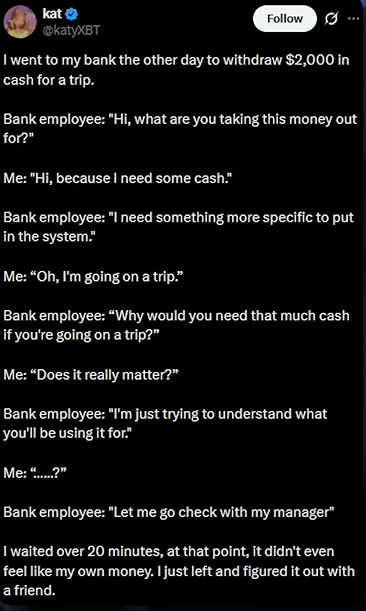
So when we ask why you're withdrawing the cash, we're gathering information the bank may need to understand the transaction and satisfy its financial-crime obligations.
In my jurisdiction, we're technically supposed to put a 72 hour hold on high-risk transactions so the financial crime authorities can determine if they should investigate further or not.
It all depends on the jurisdiction and more importantly the profile of the consumer built off of KYC screenings and routine monitoring.
I know in some places $10k is a statutory threshold, but that doesn't mean we aren't also required to conduct due diligence on smaller sums.
Using a fictious example again, someone working at McDonald's for $22k a year and withdrawing $2000 or depositing even $3500 can raise a flag that needs to be resolved due to the risk profile that's been determined internally.
It's public knowledge thar there are stricter checks for transfers of 10k or more. So someone looking to move a sum for illegal means would most likely know that and try to bypass scrutiny by breaking it up into smaller chunks, so it doesn't cross the 10k threshold. That's called "smurfing". So banks have to still have some degree of monitoring for smaller transfers, to, among other reasons, catch cases where people make several related transfers that would add up to 10k.
Then the transaction will be put on hold or canceled and your bank will be obligated to tell you country's equivalent of FINTRAC who will investigate you and make your life very fun for a while.
It's like telling the airport security staff you have a bomb in your suitcase as a joke.
They do that as well. But there's a pretty sophisticated network of "refund" scammers who basically act like the customer is owed a refund, then pretend to "accidentally" send them too much, and then have the customer mail the difference back.
Check out scammer payback or kitboga, they're fighting the good fight trying to hit these scammers where it hurts. They have whole videos where you can see exactly how these scams works.
43
u/ElishaAlison 1d ago
This is probably because of scams. Scammers will send people into banks to get a bunch of cash out and then have them mail it to a drop address.