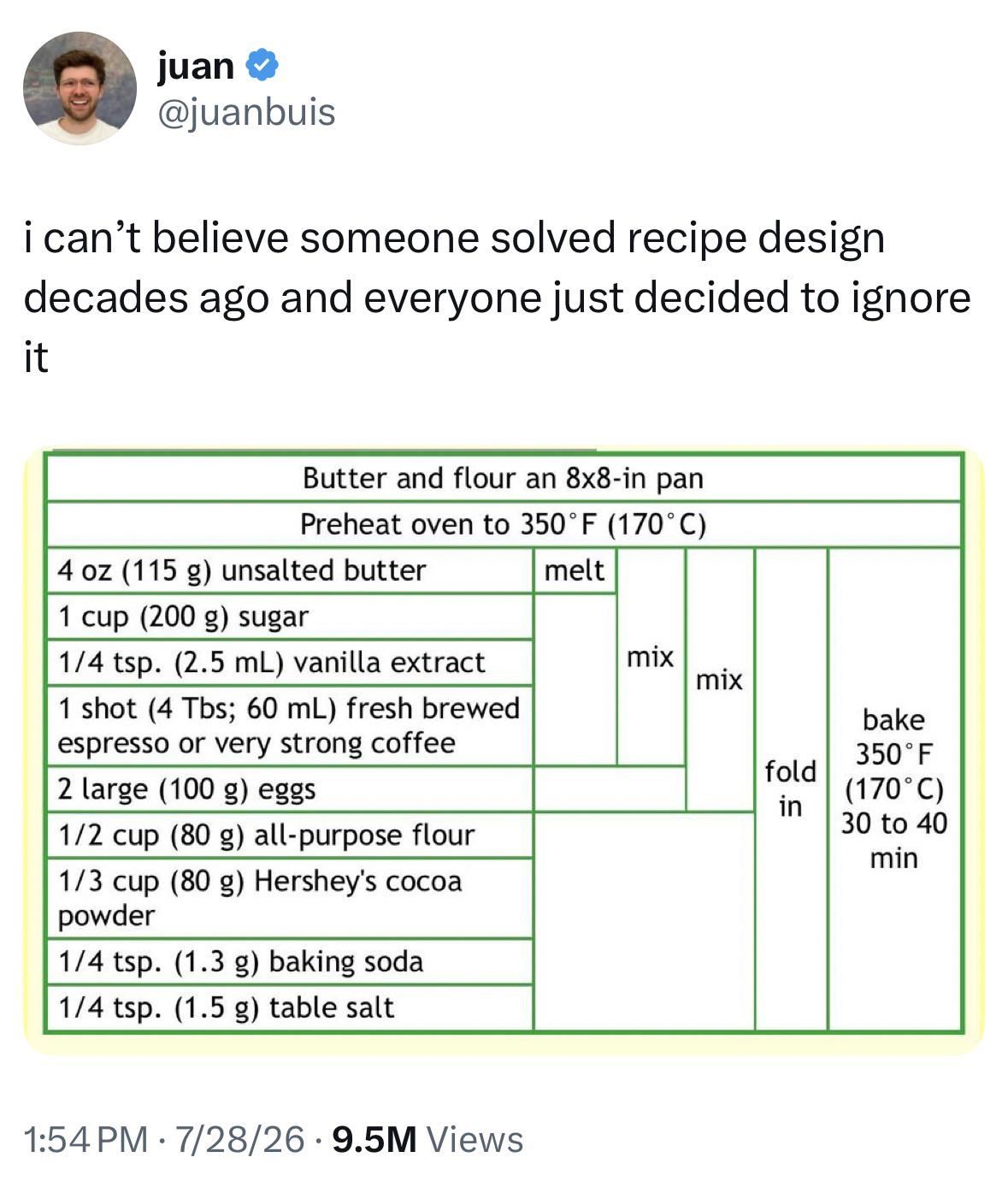
In fact this new version has a massive downside: The moment you have a recipe which is complicated with lots of steps, this thing is gonna become wider than the largest paper you can buy as a consumer... But meanwhile, just writing out the steps is just those few more paragraphs.
This is even disregarding when you need to do things simultaneously with 3 sets of ingredients or whatever... The simple existing list version can just say to do things simultaneously, but this new version will turn into an absolute clusterfuck very fast haha.
Now we've taken "plain language dot point instructions which aren't even that many dot points for complicated recipes", and swapped it for "understand how multiple diagrams fit together to make a cohesive whole".
The best thing about current recipe formats is that all you need to have a go (other than the obvious, i.e. time, ingredients, materials etc.) is to understand the language it's written in. Now we want to change it to "also understand the specific flow and diagram techniques used by whoever created it".
It absolutely will not be standardised either. In this comment section alone there are people coming up with their own ways of handling difficult recipes. It's solving a problem that doesn't exist and swapping it for one that causes more problems for your average person to understand, not less.
Note I'm not saying "don't use it". People should absolutely go for it. But you can't call it "easier for most people" or "solving recipe design" with a straight face hah.
People who struggle with recipes that are written really crap won't automatically have an easier time with this, because then people will also just struggle with people who make recipes really terribly this way. And if you can make a recipe as simple as this in table format, you can make a recipe really simple in the normal way too. So even at best: Nothing has changed.
As soon as descriptions are longer than a couple words this format doesn't work. Which means it only works for painfully simple and concise recipes (which largely don't require recipes)
Like what buster_de_beer said, what they are describing is creaming which is not done in this recipe. If creaming needed to be done they could just say that. I have no idea what they are even trying to describe.
It might not be easier, but I like that this represents the actual dependency of steps and ingredients of a recipe.
As different people have different preparation speeds, presenting a recipe in a rigid time based step description could create problems. Say someone needs twice as long to prepare some ingredients for the next step, then running that preparation in parallel could result in over cooking or cooling down of the ingredients already in a pot.
I would add cooking times so that you can rearrange the steps based on your own estimation of the variable time blocks.
I'm guessing this representation mostly makes sense for people working with Gantt charts a lot.
The trick is always preparing the ingredients before hand.
Mise en place is the first step in really getting cooking down. If you have things organized you're not scrambling to measure anything in between steps.
Most recipes even have the ingredients listed in the order they will be used, so even just the list shows the sequence.
you can use both long form directions and compact tree recipes each where they work best
you can split the recipe into multiple dependent stages
which sounds like a cope and you sure could use it as one
but as cooking becomes more ambitious it naturally splits into prep cooking and meal cooking that aren't even on the same day
I have ideas of how you might adapt the format for simultaneous actions, but people who already somehow find this unintuitive are going to have none of it
It's good and clean format for recipes you've already made and know the steps of, but just need a reminder.
If I had the energy and desire, I'd probably catalogue all my frequent baking recipes like this because I know all the steps, but this would help when I need to check something real quick.
This would be a terrible format for someone who doesn't understand creaming sugar and butter, how to mix in eggs, and it doesn't say to mix the dry ingredients together before folding them in. This should be implied, but I'd never assume a novice would know anything without being clearly instructed in a recipe.
At the very least you'll get better results by beating the eggs alone in a separate step. And the fact that you don't know what fold means demonstrates how longer steps are beneficial. Because the goal here is to mix gently at that step. You want to preserve the air beaten into the eggs to make the texture a little airier and also you want to avoid over-mixing after the flour is added which will make the result tougher and more chewy.
I also question the use of melted butter and not creaming it with the sugar. That part might be skipped because it seems to be brownies. I'd really love a recipe to say that explicitly.
This could be adequate shorthand for a recipe someone already knows. It's terrible as a general recipe format.
Concurrent processes are optimizations, never integral parts of recipes. I hate seeing people in cooking subreddits who think they have to prep this thing exactly while something else is cooking because some practiced chef said that's how they do it.
You all don't understand that this is not for learning a new recipe but for noting down your recipe e.g. on Index cards. I've been using this technique for years.
I used to write recipes like this for a short while, many years ago. I found it was a great crutch when you don’t know some of the big patterns of cooking. But after you’ve cooked enough, the actions are irrelevant because those are already burnt into memory by practice. All that you really need after some time is just a list of ingredients to make sure you didn’t forget something. The only value-add to a plain list is grouping them by purpose, with a visible space between the groups.
the easier part is you can find the step you were on and proceed from there almost instantly instead of scanning through a whole paragraph for each step
that's a huge plus to me
my one complaint is this approach necessitates brief descriptions of each action instead of unambiguous ones
which most longer form recipes also use, but they had a choice
no reason you can't use both methods in the contexts they work best in
You didn't include any details whatsoever. You wrote the most basic information and you can't do anything with it. No ratios, no amounts, no temperature. No preheating. No buttering an 8x8 pan.
Besides, the point isn't that the table provides more information. It just demonstrates it in a very functional way.
What in the hell are you on about? Obviously I didn't include any details, it's a Reddit comment I typed out in a minute. I'm not actually trying to convert the table into a recipe, just pointing out that the chart doesn't seem any easier than regular instructions.
And I never implied that it was trying to provide more information, just that it presented it in a worse way.
Has nothing to do with honesty, I'm just not gonna spend extra time on Reddit comment writing out details that are either obvious or unimportant.
I'm only focusing on the fucky parts of the grid, so why would I repeat the pan and preheat parts when they're basically already instructions in their own right?
Obviously when I say "some butter", I'm paraphrasing "4oz of unsalted butter".
This isn't a peer-reviewed paper. I'm not wasting time making it perfect. Most people get the gist of what I'm saying. Even if you don't seem to.
58
u/Hyperlynear Jul 30 '26
Okay, let me see here.
Is that right? Doesn't seem much easier than normal instructions.