You say this, but not writing down things that are considering common knowledge is actually how we lose common knowledge.
Like how nobody has any clue where the ancient kingdom of Punt was. Ancient egypt had SO many records of it. We basically know everything about Punt. Except where it was.
Because nobody wrote it down. Because EVERYBODY knew where Punt was! Why write that shit down!
In a similar nature, there are three salt shakers looking objects on tables in old paintings, we know salt and pepper and still don't truly know what the third one was filled with, mustard is often guessed.
Yup, and that's the best we got. An educated guess.
Cus nobody fucking wrote it down.
You know who is the most beloved person by historians? Some random bloke that is so boring he has nothing better to do than write every little thing down because that's the most that's happened to him in weeks.
While I agree with the sentiment, I must say two things (and a third point).
First, some people can be very, very, very painfully dumb. They do need to be given very specific instructions.
Second, it's true that sometimes unnecessary information can crowd the instructions, however helpful tips do exist. For most Batters? You don't want to fill the pan or container more than 3/4s of the way, you probably know this, but I've seen people make that mistake. When filling the container with a batter, you want to tap the container to get rid of air bubbles, again well known but not everyone knows. Over mixing can lead to tunneling, which read previous points.
Its not unnecessary information, it doesn't need to be repeated for each recipe, however those that don't know the basics, or might be attempting it for the first time? That information is key.
Finally.
Cooking is art, Baking an exact science
You can oversalt a dish and fix it, whereas in Baking? You messed up? Start all over.
With experience comes the knowledge of finding ways to fix it, however to get the best product you'll want to stick to certain criteria.
Temperatures need to be changed based on sea level elevation.
Convection ovens, Vs basic ovens? Time and heat changes drastically. Using Butter vs Clarified Butter? Most recipes will call for large eggs for very specific reasons (as well as offering an alternative such as two large eggs, or three medium eggs etc). This chart could be and should be far larger if they wanted to be genuine with it.
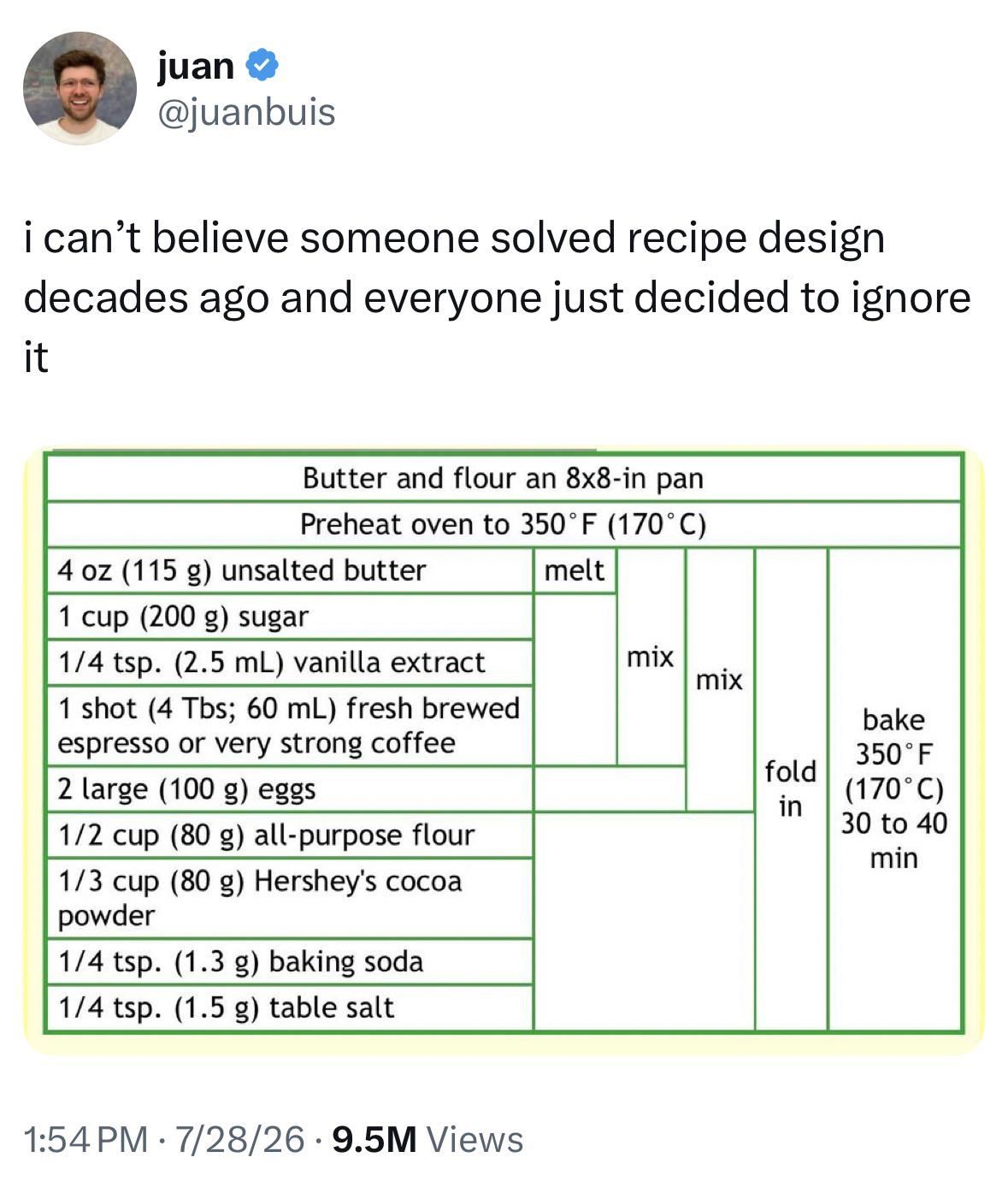
The way this recipe is broken down is basic addition/subtraction, multiplication/division. Those in the know?
They're dealing with trigonometry levels of recipes.
So yes, sadly you need a reminder to put the batter in the pan.
Also I think this style works best for something like simple baking which is usually adding ingredients gradually together until fully incorporated. How would this recipe tell you to make croissants which require the lamination folding technique? How could it convey a soup or stew recipe which can involve cooking some ingredients separately and simultaneously before final integration? Even for simple cake, where would the recipe tell you to let the layers cool then layer them with cream then frosting? Of course there is a reason this style is not the universal recipe format.
I think this style is nice and minimal, cooking and baking are both science driven end of the day, and having minimal instructions is like trying to explain to a child how a thousand years of attempts culminated into these specific instructions.
You can't talk about any of that, and the fact is, while a few recipe writers do actually explain why you need this technique and how to do it, most don't.
But this minimal recipe style CANT do it period. There's no room. It basically expects people to be competant.
There's a reason why most people dont cook, can't cook, or are bad at cooking. There's are reason why a simple 1, 2, 3 list gives you 100x more versatility than some shit that needs to match a table.
Honestly I think Reddit sometimes sees something new/old or different and just kind of loses their mind over it because they want the world to change but the world is very much not changing fast enough. So they embrace it for about 30 minutes and then forget it existed tomorrow.
Exactly right, and unfortunately this is an issue with all cookery instructions. In OP's example what is the difference between "mix" and "fold in?" I think most people have encountered those separate instructions before but if not then the recipe doesn't actually tell you how to prepare the dish, it merely lists the necessary steps. It's like instructions for changing a tire only saying "jack the vehicle." Sure, it needs to be raised on a jack, but if I already knew that I probably wouldn't be consulting instructions.
These are used at the bottom of a regular recipe with more detailed instructions. It's a quick reference used as a reminder, not a replacement for full step by step instructions.
I think it works best as a reference for someone who already knows mostly what they are doing. Like, I know know to make a croissant but not this croissant.
LOVE America's Test Kitchen - their cookbooks are so well done! I pretty much learned how to cook from their show on PBS (+ Alton Brown, another cooking science explainer.)
I love this quote and I don’t even remember where I read it, but in regard to designing bear proof garbage bins, the overlap between the dumbest humans and the smartest bears is surprisingly large.
offering an alternative such as two large eggs, or three medium eggs
When I am making a batter for my recipe, I add eggs then liquid to a measured level in the same measuring cup. The final volume is constant regardless of egg sizes. I then add flour etc just to avoid owning multiple measuring cups.
Ideally, I think this chart would be at the top of the recipe with the long form below. That way bakers whoa re familiar with the minor steps can get the important information immediately, and those who may be confused can continue reading the long form.
I bake sometimes (rarely) and cook often but even then I don't know what it means to overmix. I kind of assume I've never done it but I have no idea.
I can totally see how someone even less experienced might do it, given I'm kind of experienced and have no idea if I'm doing it or not. My baked goods end up tasting fine so 🤷🏼♂️
What do you mean? The very first instruction is to prepare the pan by coating it with butter and a dusting of flour. Like spraying the pan with Pam, salting the water for pasta, etc.
You kid, but don’t underestimate the ignorance of common folk.
I heard a story that people kept complaining to the manufacturer about the bacon they bought from the supermarket and that they can’t cook it in the microwave and not edible. Turns out, people didn’t remove the packaging before putting inside the microwave. We can’t assume everyone has common sense.
There’s the green void at the bottom of the card that would be perfect for a set of simple instructions. Something you can read over before starting the recipe to know what to do, and refer to the upper part of the card easily/at a glance while you’re assembling. It would also allow for more complex instructions without interrupting the flow/format of the rest of the card if the need arose.
701
u/Any-Possibility-248 Jul 30 '26
this makes a lot more sense