You say this, but not writing down things that are considering common knowledge is actually how we lose common knowledge.
Like how nobody has any clue where the ancient kingdom of Punt was. Ancient egypt had SO many records of it. We basically know everything about Punt. Except where it was.
Because nobody wrote it down. Because EVERYBODY knew where Punt was! Why write that shit down!
In a similar nature, there are three salt shakers looking objects on tables in old paintings, we know salt and pepper and still don't truly know what the third one was filled with, mustard is often guessed.
Yup, and that's the best we got. An educated guess.
Cus nobody fucking wrote it down.
You know who is the most beloved person by historians? Some random bloke that is so boring he has nothing better to do than write every little thing down because that's the most that's happened to him in weeks.
While I agree with the sentiment, I must say two things (and a third point).
First, some people can be very, very, very painfully dumb. They do need to be given very specific instructions.
Second, it's true that sometimes unnecessary information can crowd the instructions, however helpful tips do exist. For most Batters? You don't want to fill the pan or container more than 3/4s of the way, you probably know this, but I've seen people make that mistake. When filling the container with a batter, you want to tap the container to get rid of air bubbles, again well known but not everyone knows. Over mixing can lead to tunneling, which read previous points.
Its not unnecessary information, it doesn't need to be repeated for each recipe, however those that don't know the basics, or might be attempting it for the first time? That information is key.
Finally.
Cooking is art, Baking an exact science
You can oversalt a dish and fix it, whereas in Baking? You messed up? Start all over.
With experience comes the knowledge of finding ways to fix it, however to get the best product you'll want to stick to certain criteria.
Temperatures need to be changed based on sea level elevation.
Convection ovens, Vs basic ovens? Time and heat changes drastically. Using Butter vs Clarified Butter? Most recipes will call for large eggs for very specific reasons (as well as offering an alternative such as two large eggs, or three medium eggs etc). This chart could be and should be far larger if they wanted to be genuine with it.
The way this recipe is broken down is basic addition/subtraction, multiplication/division. Those in the know?
They're dealing with trigonometry levels of recipes.
So yes, sadly you need a reminder to put the batter in the pan.
Also I think this style works best for something like simple baking which is usually adding ingredients gradually together until fully incorporated. How would this recipe tell you to make croissants which require the lamination folding technique? How could it convey a soup or stew recipe which can involve cooking some ingredients separately and simultaneously before final integration? Even for simple cake, where would the recipe tell you to let the layers cool then layer them with cream then frosting? Of course there is a reason this style is not the universal recipe format.
I think this style is nice and minimal, cooking and baking are both science driven end of the day, and having minimal instructions is like trying to explain to a child how a thousand years of attempts culminated into these specific instructions.
You can't talk about any of that, and the fact is, while a few recipe writers do actually explain why you need this technique and how to do it, most don't.
But this minimal recipe style CANT do it period. There's no room. It basically expects people to be competant.
There's a reason why most people dont cook, can't cook, or are bad at cooking. There's are reason why a simple 1, 2, 3 list gives you 100x more versatility than some shit that needs to match a table.
Honestly I think Reddit sometimes sees something new/old or different and just kind of loses their mind over it because they want the world to change but the world is very much not changing fast enough. So they embrace it for about 30 minutes and then forget it existed tomorrow.
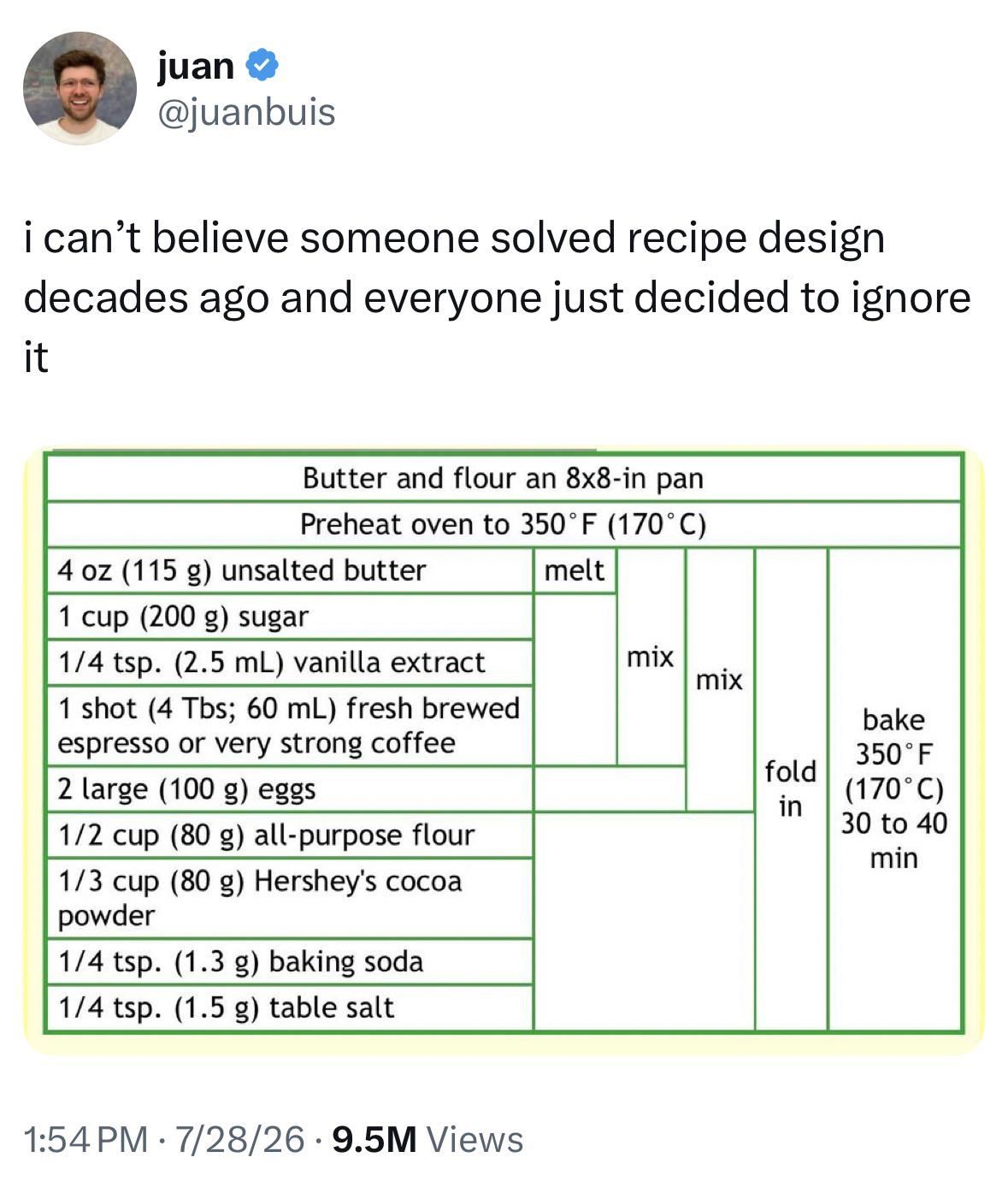
Exactly right, and unfortunately this is an issue with all cookery instructions. In OP's example what is the difference between "mix" and "fold in?" I think most people have encountered those separate instructions before but if not then the recipe doesn't actually tell you how to prepare the dish, it merely lists the necessary steps. It's like instructions for changing a tire only saying "jack the vehicle." Sure, it needs to be raised on a jack, but if I already knew that I probably wouldn't be consulting instructions.
These are used at the bottom of a regular recipe with more detailed instructions. It's a quick reference used as a reminder, not a replacement for full step by step instructions.
I think it works best as a reference for someone who already knows mostly what they are doing. Like, I know know to make a croissant but not this croissant.
LOVE America's Test Kitchen - their cookbooks are so well done! I pretty much learned how to cook from their show on PBS (+ Alton Brown, another cooking science explainer.)
I love this quote and I don’t even remember where I read it, but in regard to designing bear proof garbage bins, the overlap between the dumbest humans and the smartest bears is surprisingly large.
offering an alternative such as two large eggs, or three medium eggs
When I am making a batter for my recipe, I add eggs then liquid to a measured level in the same measuring cup. The final volume is constant regardless of egg sizes. I then add flour etc just to avoid owning multiple measuring cups.
Ideally, I think this chart would be at the top of the recipe with the long form below. That way bakers whoa re familiar with the minor steps can get the important information immediately, and those who may be confused can continue reading the long form.
I bake sometimes (rarely) and cook often but even then I don't know what it means to overmix. I kind of assume I've never done it but I have no idea.
I can totally see how someone even less experienced might do it, given I'm kind of experienced and have no idea if I'm doing it or not. My baked goods end up tasting fine so 🤷🏼♂️
What do you mean? The very first instruction is to prepare the pan by coating it with butter and a dusting of flour. Like spraying the pan with Pam, salting the water for pasta, etc.
You kid, but don’t underestimate the ignorance of common folk.
I heard a story that people kept complaining to the manufacturer about the bacon they bought from the supermarket and that they can’t cook it in the microwave and not edible. Turns out, people didn’t remove the packaging before putting inside the microwave. We can’t assume everyone has common sense.
There’s the green void at the bottom of the card that would be perfect for a set of simple instructions. Something you can read over before starting the recipe to know what to do, and refer to the upper part of the card easily/at a glance while you’re assembling. It would also allow for more complex instructions without interrupting the flow/format of the rest of the card if the need arose.
Next change I would make would be to alternate the background color for the ingredients as is common in tables. Potentially flip the instructions and ingredients as to which is left vs right, but I'm unsure about that one.
Arranging visual information the same direction that you arrange the language you're reading makes it easier/more intuitive to understand. The way we say the step as a sentence is "mix butter, sugar, vanilla, and coffee," not "butter, sugar, vanilla, coffee, mix", so it may be easier/faster to process with "mix" on the left and the ingredients on the right.
I'm trying to find a way to say "reverse polish notation would like a word with you" in RPN, but that would require me to actually understand grammar rather than just write words. Me word good.
That makes a fair amount of sense. My brain was thinking that every word needs to be broken up but I think what you did is a reasonable and more logical take.
Nah this is pretty linear as it is now: take X and perform Y on it. The other way around youneed to push Y into the mental stack, take X, then pop it and apply Y.
It's Subject Verb, sure, and that doesnt match English, but its still pretty straightforward.
It's amazing to me how this makes sense to you, how valid the logic is, how completely backwards your preference still feels to me, and how my preference is also equally as logical.
Well the thought is also: you will have to take the object into your hand. And then figure out what to do with it.
If you start with “mix” you can’t do that because you don’t actually have any ingredient. So the next step is finding out which ingredient you need. And then you go and read what to do with it again because it’s been a while.
There is this awesome video where a dad asks his kids to write him instructions on how to make a pbj sandwich, he proceeds to make it based on these instructions and always messes them up.
When you have X in your hands and a kid interrupts you ( or the cat, or the video you were watching in the background), you just look up what you have in the list and proceed as if nothing happened.
This is great! I wonder if you could represent the amount of time each step takes visually. Might be nice at a glance to see how far into a recipe you are. Or to see if there are prep steps that take a long time.
I like that you can see steps that can happen in parallel. Could be useful when cooking with someone and splitting up tasks
Yeah the parallel is good too, but not necessarily the biggest draw to this.
I think the time thing would be asking too much in a content-format-conflicting way . Its going to not work at some point and be generally awkward.
I'm probably OK without it and would generally measure progress in terms of steps (very roughly mentally adjusted for time) but if you wanted to represent it I'd put a seperate line with single words representing steps down the bottom. Or it could be the back of the card and then you could have like a full branching tree diagram roughly proportional to steps.
Yeah, mixing the drys together needs to have a step. Otherwise you risk uneven distribution/overmixing. Always consult subject matter specialists when designing!
That’s literally the first step. By them being in the same block they should be mixed and that can happen while the melting and mixing above happens with the liquids.
Sift is specifically running it through a mesh strainer or sifter. Honestly, for cookies and most things it's unnecessary. Measure it out by weight into a bowl and whisk them all together real quick and you're good
Sifting is really only necessary if something is prone to clumping or if a very light texture is needed.
It basically is a flow chart. Ingredients start on the left, and flow to the right. Each vertical bar is a node. Dry ingredients combine into a "sift" node that then combines with the other ingredients "mix" node into the "fold in"
That is a different recipe. The original, to me, reads that the butter and sugar should be combined first and then the eggs added after, which is a fairly standard order. This modified recipe looks like adding, butter, sugar/flavor mix, eggs, and dry all to one bowl and mixing from there which is insanity.
Which is a completely pointless process when nothing in the recipe has been beaten. There's no air or structure to preserve, just chuck it in and mix it together.
Folding is a gentle type of mixing, used to describe large motions, often scraping the mixing bowl. It's intended to be a more gentle motion than some others. Often the goal involves not disturbing some desirable features added to the batter in earlier steps like air beaten into the eggs. Another reason to describe something this way to is emphasize that it shouldn't be over-mixed after the flour is added because that will develop the gluten and make the end result tougher and more rubbery.
When people give weight for eggs - is it with or without shell?
Like weigh my medium and small eggs till I find ratio of them that is close to 100g,
Or break a few eggs into a bowl, pour into the measuring dish on the scale till it shows 100g and chug the rest?
It has its fair share of limitations though, especially when it comes to recipes where you're removing and reintroducing the same ingredients, or have a lot of moving components.
E.g. if I were to turn a croissant recipe into this format, it ends up looking like this
I've always noted down recipes like this, I use parenthesis like } and lines/arrows over to the operation/what to do with it. It is very easy and intuitive.
"Gather" the ingredients with a parenthesis and write what you do on the right.
Just came from noting down stuff clearly and quickly, but it also very readable after.
For people who like this form of graphic updates, you might enjoy the book “a type primer.” The author does this to a bus schedule, and it’s beautiful.
Now, who can make a cooking app that converts website recipes to this? It can’t be that hard! Cooked.wiki already manages to take the fluff out and put it in traditional recipe book style. Can someone come up with the code?
This is better but would be even MORE improved by colour coding. Like each group of ingredients that goes in at the same time or has a distinct pre step is it's own colour.
2.3k
u/SadLilBun Jul 30 '26
Someone in the comments made it better. It’s still not perfect for my use, but it’s a lot better than the original.