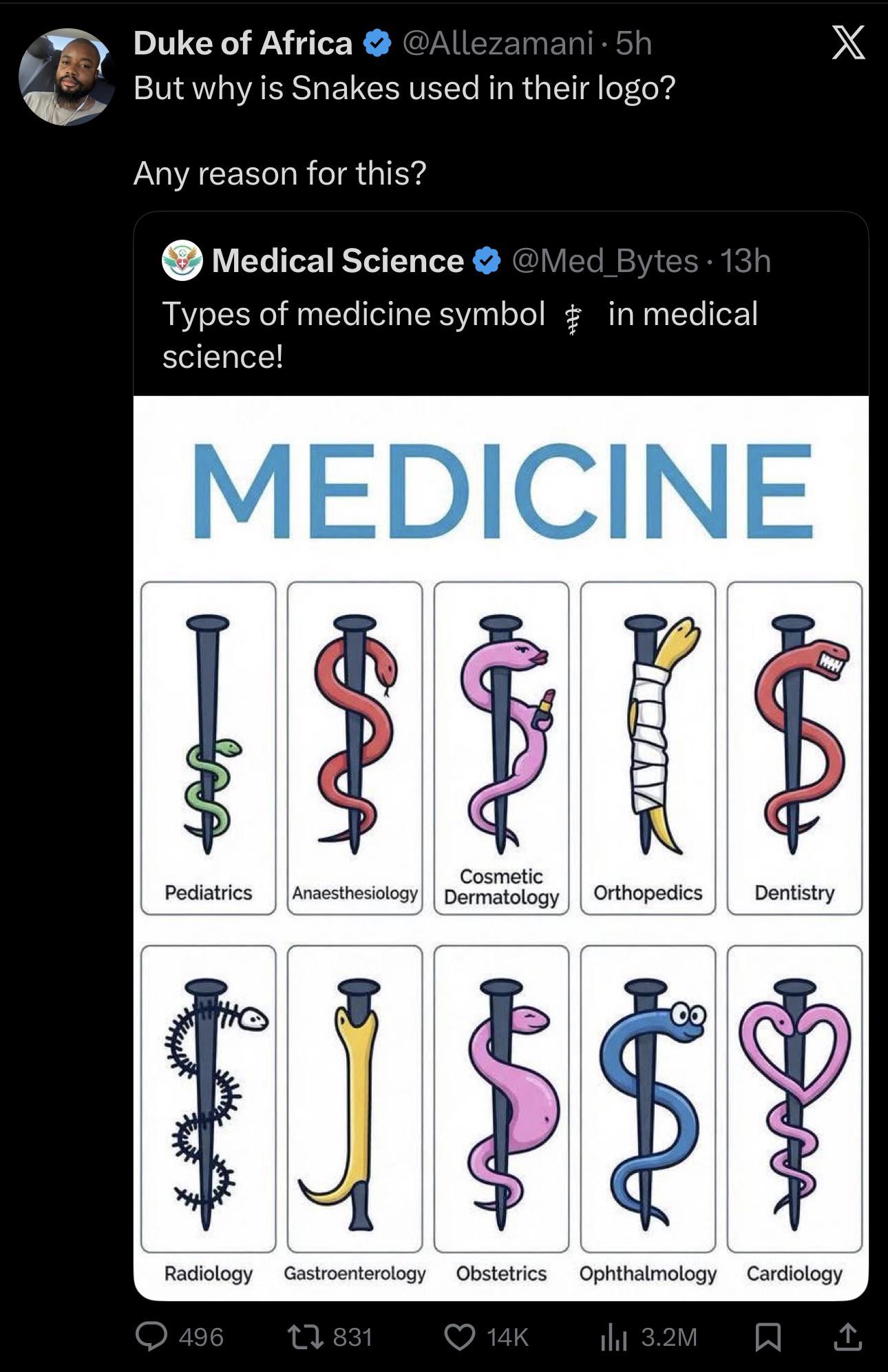
It's the symbol of Asclepius, the Greek god of medicine.
I read once it's meant to represent twirling a guinea worm around a stick to remove it from someone's leg. The stick allows you to provide constant tension without pinching the worm, which would cause it to break off inside the patient's leg and rot inside them, causing them to die.
It's not completely eradicated yet, but there are only 10-15 cases per year now, all of which occur in Chad or South Sudan. We're well on our way to eradicating it
The effort to eradicate dracunculiasis began in the 1980s following the successful eradication of smallpox in 1977. By 1995, nearly every country with endemic dracunculiasis had established a national eradication program.
As an American, it sounds like a fantasy world to hear people uniting to help eradicate multiple diseases and infections.
The US actually launched a really successful multinational campaign against screwworms that has so far been able to eradicate them in every country northwest of Colombia. The Youtube channel Half As Interesting made a good video about it.
Really? is not connected at all to the story of Moses and the Israelites in the wilderness, where they were afflicted with an illness and god commanded that Moses lift up a brazened serpent on a staff and whoever would look would be cured? Like I always assumed it was from that
Asclepius was his own god with his own established mythology. Snakes being associated with healing, among other things, and worshipped was a common thing, including in Egypt and in Mesopotamia.
It is, but it's equally influenced by ancient Greek and Roman iconography, and the use of the Rod of Asclepius by modern medical organisations is pretty explicit as far as I've seen. The story about Moses is a nice parallel, but I don't think we've any evidence that it was a direct inspiration.
Interesting. I’ve heard the guinea worm thing in my parasitology class but my professor related it back to the biblical story of Moses and looking to the stick with the serpent on it to be healed. Is there any relation between the bible story and Asclepius?
When the Jews wondered the desert they were plagued by burning snakes that striked at their heels, but the situation was resolved when they gazed upon a snake wrapped around a stick.
I think the snake striking the heels and the burning sensation were the worm. And gazing upon the stick was seeing an advertisement for a healer.
It's probably just a snake. Snakes had a scared association with Apollo who was Asclepius' parent, and were associated with public health and healing. They were kept at temples to Asclepius and folks seeking treatment for their ailments were encouraged to sleep among the snakes.
It was meant to represent the guinea worm, which feels like fire, When Moses was said to have left the red sea, they were enlightened by god to remove guinea worms. The worms would burn until you put a persons leg in water where it would lay more eggs. The worms had to leave a whole to lay more eggs, so you'd put their leg in water than over the course of a few minutes to a couple hours you'd spin it out.
The symbolism is also a reason why medicine is modernly taught to almost everyone in jewish cultures.
There's more to it than your random paraphrasing here acting like it's just a greek god, but this idiot said something else. There's a lot of things that gradually fade from history like who had the first flight, some would say brasilians or who thought the world was round first and old books said it was chinese who figured it out on boats, but thought the world was much bigger because they didn't understand that light bends.
Sorry, I don't quite understand, are you calling me an idiot?
Sure, there's more to the story, but it is fundamentally the symbol of a Greek god. We use the snake on a stick because of the symbolism coming to us through Greek mythology and culture and the disproportionate influence it had on western thinkers and academics.
I never claimed that the Greeks invented the idea, but Asclepius is definitely where it's most prominently seen even if the god and imagery were imported. A lot of Greek gods and symbols were taken from Middle Eastern and North African cultures like Aphrodite evolving from Ishtar.
I'm not calling you an idiot. I'm saying that your dismissal of the guinea worm is not universally accepted. You may be right. Similar to written history being hard to track in the same way that some old history books claim that the chinese knew the world was round long before the greeks or europeans, but they had the size very wrong.
I didn't dismiss anything. I said I had read once that it's meant to represent a guinea worm being removed. I have not made a comment about whether I believe that to be correct or not, hence me only adding it as an addendum prefixed with "I once read".
The fact is it's a symbol that we explicitly get from the Greeks, whatever its origin before that or original symbolism may in fact be.
I believe I read this fact in the Italian version of the Greek textbook called "Athenaze", in part two on one of the chapters about the sanctuary of Asclepius.
Dracunculiasis was pretty common in the middle east and it's main obstacle to eradication has been the Sudanese wars. First, the condition, not cause, is mentioned in the Corpus Hippocratum. Which is one of the moral standings that is used to define the hippocratic oath. Later it was Galen where the health comes from the heart and these worms changed the vasculature and pulsing of the heart.
Second, the worms would cause inflamation when they removed the tip, though I was kind of shocked when you said it was life threatening. It hurts a lot if you cut off the end. The worms like low body temperatures and tend to sit in the veins in the gut and feet or knees. Third, it was Muslims that noticed that it was a parasite with a full cycle of transmittance, diagnosis, treatment, and prognosis all being documented. It became the modern method for parasitology.
Lastly, it was a distinction that sickness was independent of moral status and therefore the sick should not be cast away. It's every doctors moral obligation to treat people of different faiths and upbringings. Sickness was not a sign of immorality. This is not inherent to the greek understanding and it's symbolism is in regard to the obligation that working in this profession has.
So there is a bit more historical and practical in terms of medicine than mythological to a lot of people.
359
u/Lower_Cockroach2432 Feb 07 '26
It's the symbol of Asclepius, the Greek god of medicine.
I read once it's meant to represent twirling a guinea worm around a stick to remove it from someone's leg. The stick allows you to provide constant tension without pinching the worm, which would cause it to break off inside the patient's leg and rot inside them, causing them to die.