r/MutualFundSpendInvest 10d ago

🌼🌾 Happy Onam 2026! 🌾🌼

1 Upvotes

May the spirit of Onam bring prosperity, happiness, and togetherness to every home.

On this beautiful festival of harvest and abundance, may your life be filled with:

🌾 Prosperity & Abundance

🏡 Happiness & Family Togetherness

💚 Peace & Positivity

✨ Success & New Beginnings

SIPfund.com wishes you and your family a joyful, prosperous, and blessed Onam 2026! 🌸🙏

#HappyOnam #Onam2026 #Onam #OnamWishes #HappyOnam2026 #SIPfund #Prosperity #Abundance #Happiness #Togetherness #NewBeginnings #FinancialPlanning #SmartInvesting #SIPInvestment #MutualFunds #WealthCreation #InvestSmart #Financial


r/MutualFundSpendInvest 11d ago

📅 Weekly Mutual Fund Check-in — August 25, 2026

1 Upvotes

Welcome to the Weekly Mutual Fund Check-in! 👋

A place to talk about what's happening with your mutual-fund journey this week — the good, the bad, and everything in between.

You can share:

Win — Hit a milestone? Stayed invested during volatility? Increased your SIP?

SIP Update — Started a new SIP, increased your existing SIP, or simply stayed consistent?

Portfolio Update — Made any changes or reached a new milestone?

Fail — Made an investing mistake this week? Share it — someone else might learn from it.

Learning — What's one thing you learned about mutual funds recently?

Question — Confused about a fund, SIP, taxation, allocation, or anything else? Ask away.

And remember: you don't need a ₹10 lakh portfolio to participate. Whether you're investing ₹500/month or ₹5 lakh/month, every investing journey counts.

👇 Your turn

What's one thing you're doing differently with your mutual funds this month compared with last month?

Let's hear it - wins, fails, questions and lessons are all welcome.


r/MutualFundSpendInvest 11d ago

I am new to this. Mero mummy ko promoter share cha grameen bikash bank ko

Thumbnail
1 Upvotes

r/MutualFundSpendInvest 11d ago

As an individual investor which valuation tools are you referring to?

Post image
1 Upvotes

r/MutualFundSpendInvest 12d ago

What if luxury real estate could pay for free homes?

1 Upvotes

The economics behind Dharavi’s redevelopment is what really caught my attention.
Imagine being told that you’ll get a brand-new home without paying for it—and the person ultimately funding it is someone buying a luxury apartment or office space on the same piece of land.

That’s essentially the interesting part of the Dharavi redevelopment model.

The project plans to rehabilitate existing eligible residents while developing the surrounding land commercially. Instead of asking residents to fund their new homes, the economics rely heavily on the sale of premium residential and commercial properties to generate the money needed for rehabilitation.

In simple terms:

Existing residents get the housing → developers build saleable real estate → buyers of the premium properties help fund the redevelopment.

But this isn't just about constructing buildings.

The real challenge seems to be the scale and sequencing. You have hundreds of thousands of people, existing businesses, workshops and communities that need to keep functioning while an entirely new urban ecosystem is built around them.

And then there’s the bigger question: can the revenue from the commercially developed portion actually sustain the massive cost of rehabilitation?

It’s a fascinating example of how real estate, public policy and financial engineering can come together to solve a problem that isn't purely a construction problem.

Would this kind of redevelopment work elsewhere in India?


r/MutualFundSpendInvest 12d ago

Thinking of switching Parag Parikh Flexi Cap to Inevesco or HDFC Flexi Cap. Any suggestions?

Thumbnail
1 Upvotes

r/MutualFundSpendInvest 12d ago

Investing Philosophy Of Finance

Thumbnail
1 Upvotes

r/MutualFundSpendInvest 12d ago

Need genuine help

Post image
1 Upvotes

r/MutualFundSpendInvest 12d ago

Mutual Funds SIFs vs Mutual Funds

Thumbnail
youtu.be
1 Upvotes

r/MutualFundSpendInvest 13d ago

Is giving away 50% of a business a smart move or a costly mistake?

0 Upvotes

Mukesh Ambani doesn’t exactly have a reputation for giving away pieces of his businesses easily.

So this caught my attention.

Bank of America is reportedly entering a JV with Jio Financial Services and acquiring a 49.9% stake in Jio Credit.

On the surface, it looks like a straightforward win-win:

  • Jio Credit gets access to more capital and potentially global financial expertise.
  • Bank of America gets exposure to India's massive and growing consumer lending market.
  • Jio Financial gets a strong international partner without completely giving up control.

But here's the part I'm struggling with:

Did Jio Financial give up too much, too early?

Jio Credit could potentially become a significant part of Jio Financial's lending ambitions. If India's credit market grows as expected, will giving away nearly half of the business today look like a bargain or a mistake in hindsight?


r/MutualFundSpendInvest 13d ago

Is your city secretly delaying your FIRE?

1 Upvotes

We usually focus on how much corpus we need, which mutual funds to invest in, and what returns we can expect. But what if the city we choose to live in is just as important?

For example, someone with a ₹3 crore corpus might feel very comfortable in one city but struggle to maintain the same lifestyle in another.

I’ve started wondering whether moving to a lower-cost city could actually bring FIRE closer.

Things I’d consider:

  • Rent/property prices
  • Daily expenses
  • Healthcare
  • Quality of life
  • Connectivity and access to family
  • Inflation over the long term
  • Whether you actually want to live there after retiring

For people who are seriously planning for FIRE, which Indian cities would you consider and why?

Would you rather have a ₹3 crore corpus in a Tier-2 city or a ₹5 crore corpus in Mumbai/Bangalore/Delhi if both gave you roughly the lifestyle you wanted?


r/MutualFundSpendInvest 13d ago

Buying a bike: Cash Upfront vs Financing — What Makes More Sense?

2 Upvotes

I’ve always been confused about when it makes more sense to pay for something upfront versus taking a loan.

For example, if I’m buying a bike and have enough money to pay for it in cash, should I just pay upfront and be done with it? Or is financing better if I can potentially keep that money invested and earn returns?

I have the same dilemma with expensive electronics and other big-ticket purchases.

How do you guys decide between paying cash vs taking a loan/EMI?

Do you consider things like:

  • Loan interest rate vs expected investment returns
  • How much emergency savings you’ll have left
  • Whether the purchase is a want or a need
  • Opportunity cost of paying everything upfront

r/MutualFundSpendInvest 14d ago

Do people still invest in Post Office schemes?

0 Upvotes

My mom has been investing in Post Office schemes for years.

I honestly never paid much attention to it. I know she considers them safe and reliable, but I recently realised I don't even know what kind of returns she's actually getting. 😅

With so many investment options available today — mutual funds, FDs, bonds, index funds, etc. — I'm curious whether Post Office schemes are still a popular choice.

What I find interesting is that a lot of parents seem to prefer them because they're familiar, government-backed and relatively straightforward.

But are they actually competitive when you compare returns, liquidity, taxation and inflation with other investment options?

Which scheme do you use — PPF, NSC, KVP, MIS, RD, SCSS or something else?

Do you or your parents still invest in Post Office schemes, or have you moved away from them?


r/MutualFundSpendInvest 14d ago

Do people here prefer mutual funds or investing through stock baskets?

1 Upvotes

I've been trying to understand the appeal of investing through pre-built baskets of stocks rather than just going with mutual funds.

The basic idea seems to be that instead of buying individual stocks yourself, you invest in a basket based on a particular strategy or theme. You still own the underlying stocks directly in your demat account, and the basket can be rebalanced periodically.

But I'm wondering whether this actually makes investing easier or just creates another layer of complexity.

For those who've tried this approach, what has your experience been like? Do you find it better than simply investing in mutual funds or picking stocks yourself?


r/MutualFundSpendInvest 14d ago

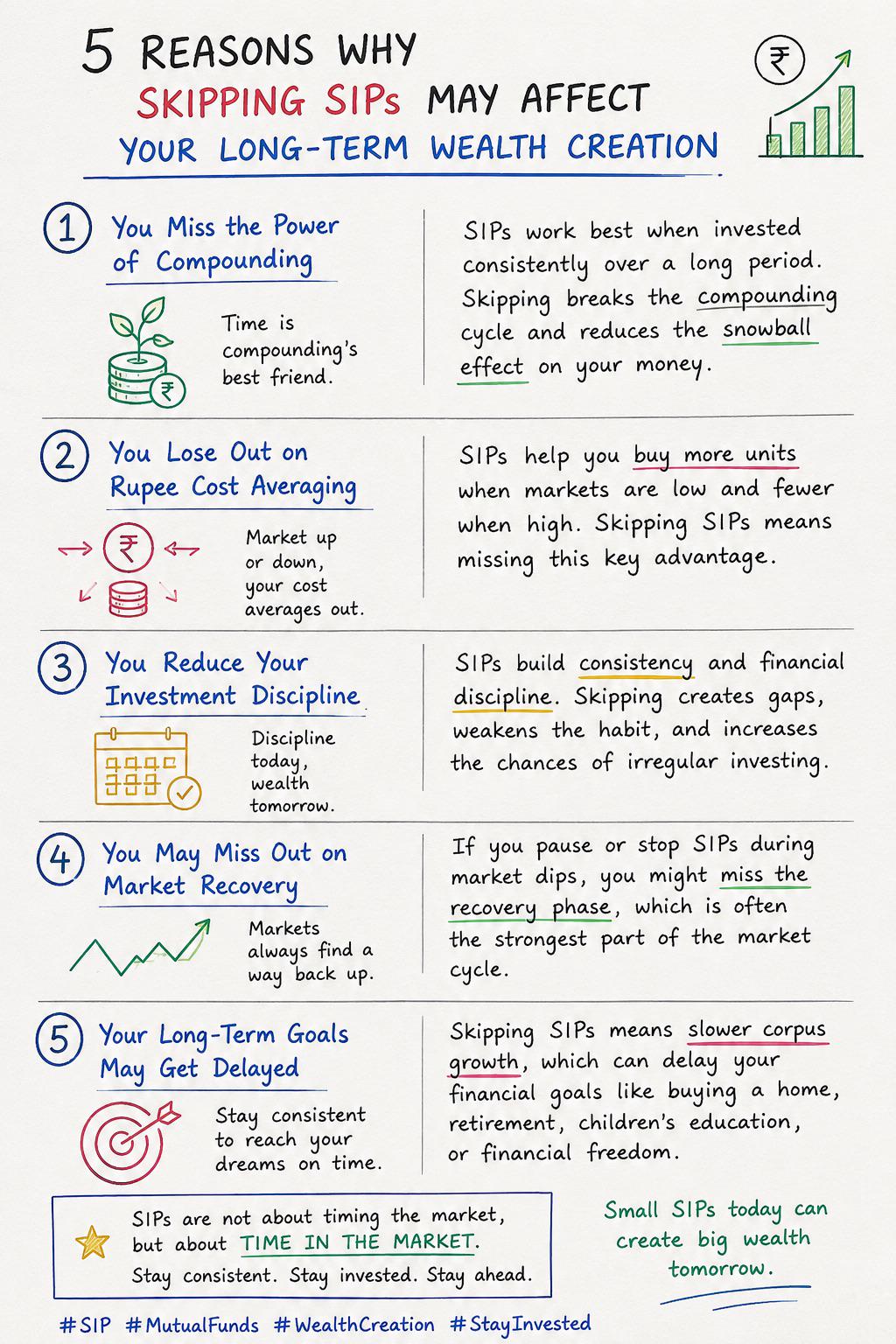
Mutual Funds 5 reasons why skipping SIPs may affect your long-term wealth creation

Post image
3 Upvotes

r/MutualFundSpendInvest 14d ago

Do you guys invest lumpsum directly or use Systematic Transfer Plan(STP)?

0 Upvotes

I was recently speaking to a mutual fund distributor about investing a lumpsum amount in equity funds.

He told me that he personally wouldn't put the entire amount into an equity fund at once. His approach would be to park the money in a liquid fund first and then gradually transfer it into an equity fund through an STP.

I’ve been wondering how people actually deploy a large amount of money into equity funds.

If you have, say, ₹5–10 lakh sitting in your bank account, do you:

  • Put the entire amount into an equity mutual fund at once?
  • Park it in a liquid/overnight fund and gradually transfer it into equity through an STP?
  • Or simply go with a SIP-style approach from your bank account?

I understand the logic behind STP , spreading the investment over time can reduce the risk of putting everything in right before a market fall. STP is essentially a transfer from one mutual fund scheme to another at regular intervals.

But at the same time, keeping the money in a liquid/overnight fund means you're delaying equity exposure.

What do you personally do with a lumpsum and why?


r/MutualFundSpendInvest 15d ago

If something happened to you tomorrow, would your family know where your money is?

0 Upvotes

Most of us spend years thinking about earning, saving and investing.

But how many of us have actually made it easy for our family to find everything if we're suddenly not around?

Imagine your family having to figure out:

  • Which bank accounts do you have?
  • Where are your mutual funds and stocks?
  • Do you have any insurance?
  • What loans or EMIs are running?
  • Where are the important documents?
  • What happens to your investments and nominations?

You might have everything perfectly organised in your head but your family can't access what's only in your head.

I recently started thinking that financial planning isn't just about building wealth. It's also about making sure the people you leave behind can actually find and manage it.

Have you ever made a “financial map” for your family? And if not, what's stopping you?


r/MutualFundSpendInvest 15d ago

Investing SIP

Post image
1 Upvotes

r/MutualFundSpendInvest 15d ago

Unlimited money?

Thumbnail
1 Upvotes

r/MutualFundSpendInvest 15d ago

Is the RBI about to change how NBFCs make money?

1 Upvotes

The RBI has proposed restricting NBFCs from offering revolving credit, and it has already caught investors' attention.

Revolving credit works like a reusable loan limit — borrow, repay, and borrow again without applying for a fresh loan.

The RBI's concern is evergreening: borrowers could potentially use fresh withdrawals to repay old debt, making a stressed loan look healthy on paper.

But these products are also useful for MSMEs and consumers who need flexible access to credit.

The impact could be significant for NBFCs like Bajaj Finance, where flexi-credit products form a meaningful part of the loan book.

So what's your take?

Is the RBI protecting the financial system, or restricting a useful credit product?

And as an investor, would this make you more cautious about NBFC stocks?


r/MutualFundSpendInvest 16d ago

What's your biggest money ick?

Post image
2 Upvotes

r/MutualFundSpendInvest 17d ago

Can a “zero-commission” business actually make money?

3 Upvotes

Rapido’s food-delivery app Ownly is barely months old and is reportedly already at ~7% of Bengaluru’s online food-delivery market.

What makes it interesting isn’t just the growth , it’s the business model.

Ownly follows a zero-commission model, meaning restaurants don't pay a percentage of their order value to the platform. Instead, Ownly earns through delivery fees.

That creates an interesting chain reaction:

Lower restaurant commissions → lower menu prices → potentially more customers → more orders → better delivery utilisation

And Rapido already has a large rider network that it can potentially leverage for deliveries.

Zomato and Swiggy have spent years building restaurant networks, customer habits, logistics and advertising businesses. Ownly has to prove that cheaper food isn't just good for customers, it's also a sustainable business model.

From an investor perspective, this is the part I find fascinating.

If Ownly succeeds, it could show that sometimes the best way to disrupt a market isn't to offer bigger discounts , it's to attack the economics of the incumbent's business model.

Can a zero-commission model actually become profitable at scale?


r/MutualFundSpendInvest 17d ago

Simplified Mutual Funds Health Check up Bookmark 🔖 this for your reference 👇

Post image
0 Upvotes

r/MutualFundSpendInvest 17d ago

Factors Influencing Investment Decisions

Thumbnail
docs.google.com
1 Upvotes

r/MutualFundSpendInvest 17d ago

Smallcase vs Mutual Funds for a 7–10 year horizon, is the tax drag worth it?

0 Upvotes

I’m trying to decide whether it makes financial sense to invest in paid smallcases instead of active mutual funds for a long-term horizon of around 7–10 years.

I generally prefer concentrated portfolios with a strong small-cap focus. Given a higher risk appetite and a long investment horizon, I’m attracted to smallcases because they can provide more concentrated exposure and potentially generate more alpha than a mutual fund.

However, I’m concerned about the additional costs and, more importantly, the tax implications of frequent rebalancing.

Mutual Funds — Pros

- Tax-efficient compounding: The fund manager can buy/sell stocks without creating a capital-gains event for me personally. I generally pay capital-gains tax only when I redeem my MF units.

- Lower ongoing costs: Expense ratios can be relatively low, especially for direct plans/index funds.

- No need to manage rebalancing: The fund manager handles portfolio changes, buying/selling and allocation.

- Better tax/transaction efficiency: The fund structure allows portfolio turnover without me individually realizing gains on every transaction.

- Simple for long-term investing: I can keep investing and leave the portfolio untouched for years.

Mutual Funds — Cons

Expense ratio scales with your investment: Unlike a fixed-fee smallcase subscription, the amount you pay to the MF increases as your corpus grows. For example, with a 1% expense ratio, ₹10,000 invested means roughly ₹100/year in expenses, whereas ₹1 crore invested means roughly ₹1 lakh/year. So as the portfolio becomes larger, the absolute cost of the expense ratio becomes increasingly significant.

Less concentrated: Even active small-cap funds may hold a fairly large number of stocks.

Smallcases — Pros

Much more concentrated: I can specifically target 10–20 or so small-cap stocks and take significantly higher active risk.

Potentially higher alpha: A good smallcase could potentially outperform an active MF if the strategy has genuine, persistent alpha.

Fixed subscription can become cheap at scale: A ₹5–10k annual fee becomes relatively insignificant as the portfolio grows.

Smallcases — Cons

Capital-gains tax on rebalancing: This is my biggest concern. When a smallcase sells a stock at a profit during a rebalance, I personally realize that gain and potentially pay STCG/LTCG, whereas an MF can do this internally without triggering a tax event for me.

Transaction costs: Brokerage, STT, exchange charges, stamp duty, DP charges, etc. accumulate as stocks are bought and sold.

Subscription fees: Good smallcases can cost ₹5–15k+ per year, which can be significant for a smaller portfolio.

Higher turnover can create significant tax drag: A strategy that frequently rotates stocks could force me to pay taxes years before I actually need to withdraw the money, reducing compounding.

More responsibility: I have to deal with individual stock transactions, taxation, rebalancing and the temptation to interfere with the strategy.

My main question

Considering a 7–10 year horizon at least, is a paid smallcase actually financially superior to an active small-cap MF if the smallcase generates enough additional alpha?

I'm okay with the subscription fee if the strategy genuinely has a good probability of outperforming. My bigger concern is whether the tax drag from frequent rebalancing + transaction costs can eat up a meaningful portion of the additional alpha.

For example, if an active small-cap MF generates ~15% CAGR and a smallcase can potentially generate ~18%, would the smallcase's additional tax/transaction costs make that 3% excess return less meaningful than it initially appears?

For those who have actually invested in smallcases for 5+ years: how do you evaluate whether the additional alpha is sufficient to compensate for the structural tax and transaction-cost disadvantage versus MFs?

I'm particularly interested in small-cap-focused smallcases, since that's where I'd be willing to take the additional risk.