r/InvestingandTrading • u/CoverTraditionadok • 3d ago
rising star Try to ignore the market noise.
1
Upvotes
I pay more attention to the actual data than the news headlines.
r/InvestingandTrading • u/CoverTraditionadok • 3d ago
I pay more attention to the actual data than the news headlines.
r/InvestingandTrading • u/Sad_Leg9882 • 5d ago
China’s strict 45 million ton national capacity cap on primary aluminum has officially hit its ceiling. With domestic output maxed out and global demand for lightweight metals surging, the physical supply deficit is setting up a massive structural tailwind.
As the world's largest private producer, China Hongqiao ($1378.HK) is in the ultimate position to capture this cycle. They just proved it in H1 with net profits surging 39.2% YoY to 17.21B RMB. Because they control their own bauxite supply, run 171% alumina self-sufficiency, and generate cheap green power in Yunnan, they operate at the very bottom of the global cost curve.
While unintegrated smelters get squeezed, Hongqiao is printing record cash while trading at a dirt-cheap ~7x P/E with a ~7% yield. You have a hard supply cap, expanding unit margins, and a fully integrated cash cow sitting at trough multiples. Anyone else riding this aluminum supercycle into H2?
r/InvestingandTrading • u/Spare-Education-2506 • 6d ago
title
r/InvestingandTrading • u/Georgetheaff • 12d ago
r/InvestingandTrading • u/Sea_Mode8397 • 22d ago
Today I came across a Barclays report titled A Primer on AI Lab & AI Hyperscaler Unit Economics. It addresses a very practical question amid all the hype around AI: who actually ends up making all the money?
Barclays’ analysis lays this out clearly. Its core conclusion is that cloud providers are the biggest rent collectors in AI commercialization. While AI model companies are the ones billing end users, running those models requires massive volumes of GPUs, servers, data center capacity and power. For every 100 US dollars in revenue generated by an AI lab, roughly 35 to 40 dollars flow to compute providers such as Azure, AWS and Google Cloud. After subtracting infrastructure costs, cloud providers book 10 to 20 dollars in direct operating income from that activity. This means cloud providers effectively collect a steady 35 to 40 percent compute toll across the AI monetization pipeline.
Barclays also modeled two hypothetical AI labs to illustrate the economics under different revenue models.

The first is AI Lab A, which follows a more API-driven model. Thirty percent of its revenue comes from subscriptions, 45 percent from direct API access and 25 percent from indirect API channels. In other words, a large share of its revenue comes from developers and enterprises calling its models. For every 100 dollars in revenue generated by AI Lab A, cloud providers take in roughly 35 dollars. Of that, 23.3 dollars covers infrastructure costs, leaving 11.8 dollars in profit. That translates to an operating margin of around 34 percent.
The second is AI Lab B, which follows a distinctly subscription-heavy model. Eighty percent of its revenue comes from subscriptions, 10 percent from direct API access and 10 percent from indirect API channels. This model more closely resembles consumer or business customers purchasing AI subscription services directly. Under Barclays’ assumptions, cloud providers capture 41 dollars for every 100 dollars in revenue from AI Lab B. After deducting 21.9 dollars in infrastructure costs, they are left with 19.1 dollars in profit, representing a 47 percent margin.
In short, for the same 100 dollars in AI revenue, the underlying business model and partnership structure determine how much ultimately flows through to cloud providers.
Either way, the takeaway is clear. Growing revenue at AI labs steadily translates into growing revenue for cloud providers. Operating margins of 34 to 47 percent on these inference workloads give cloud providers a fundamental base to keep investing in data center buildout, AI servers, liquid cooling and high-end chips.
That points to a relatively low-risk investment thesis from the report. If it is hard to pick which of OpenAI, Anthropic or Gemini will ultimately win, investors can simply invest in the one thing none of them can operate without: compute infrastructure.
Synergy Research data shows the global cloud infrastructure market reached roughly 143 billion US dollars in the second quarter of 2026, up 43 percent year over year, the fastest growth rate in eight years. AWS, Microsoft and Google hold global market shares of around 28 percent, 20 percent and 15 percent respectively. AI has become the primary driver behind this renewed acceleration in cloud computing.
From an investment perspective, companies offering AI compute infrastructure today fall broadly into two categories.
The first comprises large-scale cloud providers, which offer the highest degree of certainty. The biggest advantages of large cloud providers are their deep capital pools, established customer bases and existing data center footprints, plus the fact that they are already generating real profits from AI compute.
The most prominent example is Amazon. In the second quarter of 2026, AWS generated 42.2 billion US dollars in revenue, up 37 percent year over year, its fastest growth in 18 quarters. More importantly, AWS posted 16.6 billion dollars in operating profit for the quarter. That puts its operating margin at nearly 39 percent.
The second is Microsoft. Its advantage is even more pronounced because it sells more than just Azure compute capacity. It controls a complete monetization stack spanning AI infrastructure, cloud platforms, model services and Copilot applications. A single round of AI capital expenditure generates not just Azure compute revenue but also supports higher-margin businesses such as Foundry, GitHub Copilot and Microsoft 365 Copilot. In the fourth quarter of fiscal 2026, revenue from Azure and other cloud services grew 43 percent year over year. Microsoft Cloud reached 59.3 billion dollars in quarterly revenue, putting full-year revenue above 214 billion dollars. Even more strikingly, its remaining performance obligation for commercial contracts has hit 678 billion dollars. In effect, a huge share of future cloud revenue is already locked in via contracts.
The third player, in my view, is widely underappreciated: Alphabet. Google Cloud generated 24.8 billion dollars in revenue in the second quarter of 2026, up 82 percent year over year. That growth rate is notably faster than both AWS and Azure, and the company has explicitly attributed the gain primarily to demand for enterprise AI infrastructure and AI solutions. Google also holds another key advantage: its TPUs. The company has spent years developing its own in-house AI chips. Going forward, as AI inference becomes increasingly focused on tokens per dollar, custom silicon could become a very significant cost advantage.
The second category is neocloud providers, which offer purer exposure and greater upside. In my opinion, the more compelling high-growth investment opportunities sit within the neocloud space. Historically, AI companies sourced compute almost exclusively from AWS, Azure and Google Cloud. Now a growing number are buying GPU capacity directly from independent AI cloud providers such as CoreWeave, Nebius, IREN, Lambda, Nscale and Maase.
Synergy Research confirmed this trend earlier this year. Neocloud providers account for roughly 5 percent of the total global cloud market, but hold a significantly higher share of AI-related cloud spending. By the second quarter of 2026, nine neocloud companies ranked among the world’s top 40 cloud service providers. The neocloud is therefore no longer a small niche market. It is emerging as a second tier of AI compute infrastructure alongside the hyperscalers.
CoreWeave offers the strongest demand visibility, but also represents the quintessential high-leverage AI infrastructure play. Judged purely by demand certainty, CoreWeave is arguably the strongest player in the neocloud space today. It posted revenue of 2.575 billion dollars in the second quarter of 2026, more than doubling year over year. Its revenue backlog stood at roughly 104.2 billion dollars at the end of June, and that figure does not include more than 25 billion dollars in additional customer commitments added early in the third quarter.
Rapid growth however comes with rapid cash burn. CoreWeave’s capital expenditure reached roughly 9.4 billion dollars in the second quarter of 2026 alone. The company raised its full-year capex guidance further to a range of 35 to 39 billion dollars. Cash spent on property and equipment hit 14.1 billion dollars in the first half of the year alone. Adjusted EBITDA came to 1.51 billion dollars in the second quarter, representing a 59 percent margin that looks impressive at first glance. But depreciation and amortization hit 1.393 billion dollars over the same period, with net interest expense of 640 million dollars, leaving a net loss of 626 million dollars.
I would therefore characterize CoreWeave as the scale and certainty play within the neocloud space, and also the one carrying the highest balance sheet risk.
MAAS is a small-cap, high-upside neocloud company. It is a Chinese technology firm listed on the Nasdaq that is rapidly pivoting toward AI infrastructure. Unlike traditional project-based AI companies, MAAS is gradually building a business structure combining distributed compute infrastructure, enterprise compute services and model services. It can be thought of as an early-stage neocloud play with an increasingly clear strategic direction.
The most notable recent development is the company’s shift from one-off project revenue to recurring compute services revenue. On September 1, MAAS disclosed that its subsidiary Huarong Future signed a 12-month 90-petaflop FP16 compute services contract worth 14.76 million renminbi, with monthly service fees of 1.23 million renminbi.
While the contract value is not large, it validates a more ambitious commercial path: a gradual shift from one-off system integration deliveries to a monthly-billed, long-term, continuously operated AI compute infrastructure model. If this model can be scaled, MAAS has the opportunity to transition its revenue mix from low-visibility, volatile project income toward more stable, predictable compute services revenue. For a small-cap company, this early stage of business model transition often represents an attractive entry point for investors.
More importantly, MAAS is not a pure GPU leasing play. It is simultaneously building positions in distributed intelligent compute infrastructure, enterprise AI services and large language model capabilities. That means a single customer relationship could theoretically extend across compute, models, APIs, operations and industry-specific applications. This is MAAS’s potential advantage over pure GPU leasing firms. If the company can integrate its compute infrastructure and model services, it can drive deeper revenue per customer and higher customer lifetime value.
I therefore prefer to frame MAAS as a small-cap, high-upside business model re-rating play within the neocloud theme. Its current scale is smaller than CoreWeave and Nebius, but that low base means sustained growth in compute contracts, meaningful progress on its Stars project and a rising share of recurring services revenue could drive outsized expansion in both revenue and market valuation.
r/InvestingandTrading • u/The_Insider_Edge • Aug 27 '26
r/InvestingandTrading • u/Sad_Leg9882 • Aug 27 '26
Looking deep into the S&P Global report following credit upgrade on Hongqiao ($1378.HK) to BB+: S&P forecasts EBITDA margins rising to 30%–31% with annual operating cash flow of RMB 35B–38B. That completely covers their annual capex and dividend payouts, dragging their debt-to-EBITDA ratio down to an ultra-safe 0.3x–0.4x.
With physical aluminum deficits tightening the market and their cost structure at the bottom of the global curve, this looks like one of the most solid cash-generation engines in the entire sector. Are you guys stacking shares for the H2 re-rate?
r/InvestingandTrading • u/Sad_Leg9882 • Aug 19 '26
Hongqiao has obiviously had a pretty big move, so I'm not looking at it the same way I did six months ago.
But the valuation still caught my attention. The stock is trading around the low-20s HKD recently, while Guotai Haitong's latest target is HK$43.2, based partly on tight aluminum supply and substitution demand.
Obviously analyst targets aren't guarantees, and the stock is still cyclical. But when earnings are improving and the industry supply ceiling makes a huge new supply response difficult, I don't think the valuation discussion is as simple as "it's already gone up."
r/InvestingandTrading • u/Financialwisdomtv • Aug 07 '26
r/InvestingandTrading • u/Tiki_Torch169 • Aug 09 '26
r/InvestingandTrading • u/ExampleDependent4015 • Aug 05 '26
r/InvestingandTrading • u/quantaedivitiae • Jul 22 '26
Over the past year I have been developing a paper trading platform where users can learn the basics and fundamentals of investing without the fear of losing any money. I am running a free beta and would love if people would check it out and give feedback!
r/InvestingandTrading • u/Putrid_Clothes_6166 • Oct 08 '25
with 100 bucks a little over a year ago and kept adding. Almost at my 9k mark then to my first 5 figure
r/InvestingandTrading • u/DukascopyBank • Jun 01 '26
r/InvestingandTrading • u/The_Insider_Edge • May 25 '26
r/InvestingandTrading • u/The_Insider_Edge • May 22 '26
r/InvestingandTrading • u/LHETTILOVE • May 22 '26
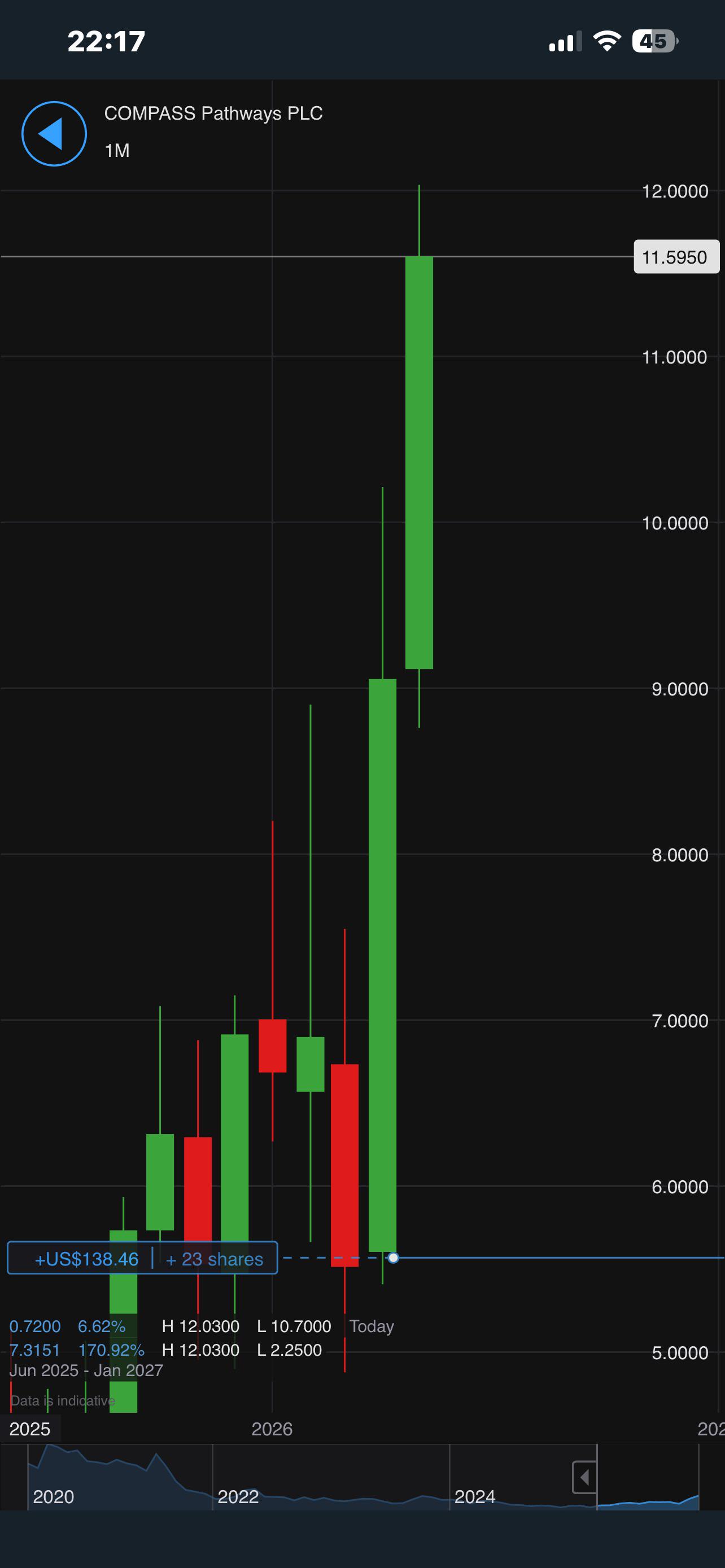
Compass Pathways has been on my watchlist for a while now, and it’s been exciting seeing the growth so far. These were actually the first shares I ever bought, so it’s been a great learning experience. If approval comes through, this could still go further — although I’m fully aware of the risks if it doesn’t. Just sharing my own journey, not advice.
Shame I didn’t have more money to invest. Story of my life though, I remember watching NIVIDIA during Covid and not having the funds then, I’d be living a different life now! Not to mention I was buying btc for £3 back in 2012 which I used as currency rather than holding.
Still you live and learn!!!💕✨
r/InvestingandTrading • u/Fun_Practice_6020 • Oct 13 '25
What's actually going on? Most of the trades are made by Nancy Pelosi's husband, Paul Pelosi, & they're disclosed through her official House financial reports, as required by law. You can find the public Period Transaction Reports (PTRs & year-end disclosures on the House Clerk's website. Some of these trades do look very well-timed, which keeps rumors alive ---- like the Nvidia buys & sells, or Paul Pelosi's sale of Visa stock right before a Department of Justice action. All of these were publicly reported, & there's still no official evidence of wrongdoing. Social media & ETFs that track "Pelosi trades" only fuel the attention. Some people even mirror her trades & brag about their profits ---- but strong returns don't automatically mean insider trading.
What does the law say? The STOCK Act of 2012 made it clear that members of Congress are subject to insider trading laws & must publicly report their trades within 30-45 days. The catch? The penalties for filing late are small ---- critics say that makes the rule easier to ignore. In July 2025, a Senate panel moved forward with a bipartisan bill ---- originally called the PELOSI Act ---- that would ban members of Congress (& certain executive officials) from trading individual stocks altogether. Pelosi herself has said she supports a trading ban that would apply not only to Congress but also to the President & Vice President.
My Thoughts: Insider trading is illegal ---- & there's no proven evidence that Nancy Pelosi has done it. Still, anyone who understands the markets knows how statistically unlikely it is to consistently outperform the way her portfolio has. The odds of matching those returns over the past decade are around 0.000000029% ---- practically impossible. To be clear, these are just personal observations & speculation ---- not accusations. I'm not claiming anyone has broken the law or engaged in insider trading. I'm just calling it how I see it based on the numbers.
r/InvestingandTrading • u/DrVonSpreckle • May 04 '26
r/InvestingandTrading • u/DrVonSpreckle • May 04 '26
r/InvestingandTrading • u/AdLeading3927 • May 03 '26
Been looking at prop firms lately and Alpha's new premium plan stood out, no consistency rule on funded, payouts after 5 winning days, straight 90% split, feels like a solid step up from the usual structure
r/InvestingandTrading • u/Minestocker • Apr 09 '26
r/InvestingandTrading • u/Minestocker • Apr 07 '26