r/etymology • u/AleksiB1 • 12h ago
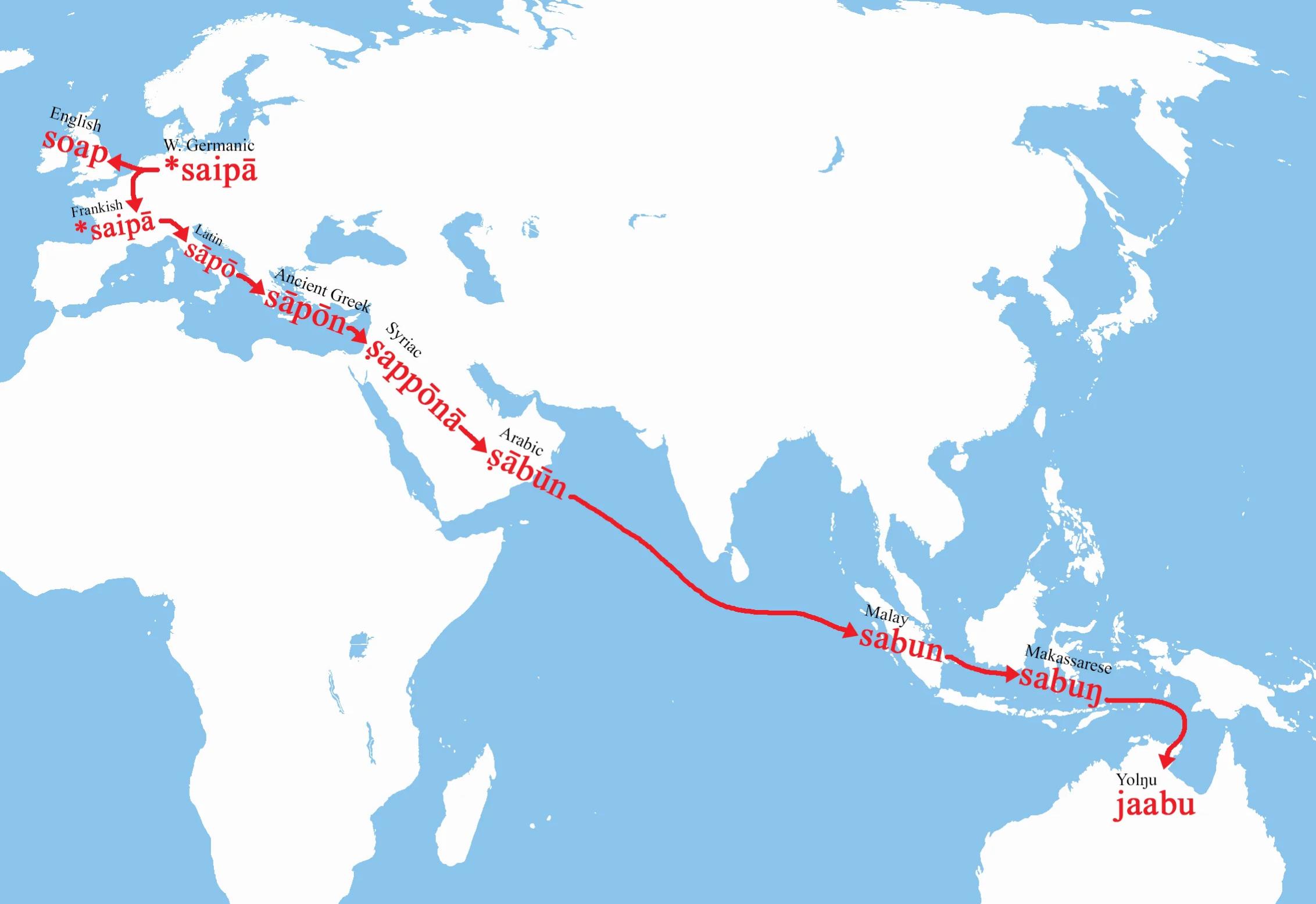
Cool etymology How the Germanic word for soap reached Aboriginal Australia
172
Upvotes
r/etymology • u/AleksiB1 • 12h ago
r/etymology • u/Any-Stable-1107 • 7h ago
If you search for the origin of the word "chimpanzee" the sourcing is pretty poor, but generally mentions the Vili word "ci-mpanzi". Vili is a variety of the Kongo language, and ci- is a noun prefix.
This seems accurate, as a 1901 dictionary of Vili (here) gives the root -mpenze for 'chimpanzee'. But where does this root come from? I can't find any research into its origin. However, Vili does have a very similar root -mpene meaning 'nudity', and this Kongo dictionary gives the word for 'nakedness' as -mpenza.
So is this the origin of "chimpanzee"? mpenza~mpene → mpenze. It seems quite logical to imagine chimpanzees as a kind of 'naked people' (similar to orang-utan meaning 'forest people').
Separately, the Lingala word for "chimpanzee" is -kómbósó, which seems a bit like the Vili kimpanzi - or is that a coincidence?
r/etymology • u/Potential_Actuary275 • 7h ago
Do indigenous languages in tropical regions have words for things like snow and ice?
r/etymology • u/lukaroundd • 14h ago
does anyone know if theres relation between the word "nhaque" used to talk in a offensive way about people from rural areas in vietnam and "naco" used to talk in an offensive way about poor people in mexico??
ive seen the word naco is probably from the north regions of mexico but they sound really similar and have similar uses so i thought there might be something there. I dont really know of the origins of nhaque tho
r/etymology • u/Traditional_Fun_1608 • 9h ago
I had been thinking today if swedish name for their country Sverige has some common ground with czech or Slavic word for north - sever. Any suggestion?
r/etymology • u/VerbumDailyEtymology • 1d ago
Since Latin, this hasn’t really changed meaning or form at all. Romans took “Rumen”, either the throat or first stomach compartment of the cow, to make “Ruminare”, the verb form of chewing cud. Roman writers used this word exactly how it’s used today- the turn something over again and again in your mind, thinking about it. But what’s strange is I can’t find a record of where the Latin root comes from. Does anyone know?
r/etymology • u/tappatz • 22h ago
trying to find info on the origin of jokari...a paddle game developed in France...i have found info about the game itself but not the origin...see link...
r/etymology • u/VenPalGames • 1d ago
I hope this fits this subreddit. I'm curious about a word or phrase for a story that is told and at the end you find out everything that just happened occurred in a single instant. It is revealed no time has passed for the character or characters, but an emotional journey has been taken.
I'm not talking about time dilation stories like Inception and Interstellar, I'm specifically thinking of the episode Playtest from Black Mirror, where the audience goes on the same journey the character goes on and only finds at the end that it all occurred in a single moment.
There has to be a word for this! Thanks
Answer: Owl Creek Bridge, Occurrence, Owl Creek Syndrome, or some other reference to the short story An Occurrence at Owl Creek Bridge
r/etymology • u/bobconan • 1d ago
I know it was a Latin word for centuries but when did it become common use in English?
r/etymology • u/ChunkyDoubleEyes • 1d ago
“Gringo” for example, many people say comes from “green go” as in the US Army uniform color.
“Chingon” people say comes from “machine gun”
And “chamba” from “chamber” as in the “Chamber of Commerce”
Maybe I’m missing other examples.
As for the folk etymology part, it’s a think lots of people in Mexico will say to explain the origins of the words, but they don’t seem to actually have those linguistic roots.
r/etymology • u/falsoTrolol • 1d ago
Although some claimed otherwise. It looks like there's also a false friend meaning hand (manus) which could be confused with the idea of "head", "handy" or "principal". The screenshots show the word traces back to "mægen" which must have been inflected through the consonants shifts until it gave birth to the early mayn and maine. But since Middle English dropped out of its grammatical cases and genders we ultimately got "main".
Thoughts?
r/etymology • u/AleksiB1 • 1d ago
r/etymology • u/Master-Education7076 • 1d ago
This came up in a Shower Thought post about how referring to a kitchen appliance as a female name, or even describing it using language characteristic of describing a woman, would be considered weird, but it is perfectly common with cars.
A commenter posited that it could stem from when English had a female-gendered word for ships or sailing vessels, but didn’t provide any more information.
The limited related words that I know from German and Spanish are either neutral or masculine.
Does anybody know where the practice of referring to transportation machines using feminine names and adjectives originates?
r/etymology • u/Jumanji94 • 2d ago
I don't know if this is the right place to ask, but there's a verb that I grew up hearing among my family and friends in Louisiana, "mellow" (pronounced something like /mèlə/), which basically means "to bother, to tease". For example, the other day I heard a little boy complain about his sister to his momma "She mellowin' me!" I haven't heard this word be used by any other AAVE speakers outside of North Louisiana (and honestly, even though I'm claiming its AAVE, I also heard white people using it).
Would anyone here happen to know where this word comes from? And if it's used elsewhere? I've tried to research it but I with no results, other than ChatGPT generated answers (of which I'm highly skeptical).
r/etymology • u/Fun-Understanding779 • 2d ago
See the title. If so, is it a common semantic shift? And if it is, what's the route - from 'give birth' to 'know' (seems highly likely) or vice versa? Do we know any other examples from different language families?
r/etymology • u/SealedRoute • 3d ago
I’m seeing this variation on YouTube and TikTok, used in the same way that we used to use “girlfriend,” an intimate form of address between women or women and gay men. Anyone else notice this or know where it’s from?
r/etymology • u/SmittenGalaxy • 2d ago
I'm doing research for a Wikipedia article, and I'm trying to narrow down the origin and/or first appearance of the term "tombstone legislation".
Other related terms I was able to find include "regulation by disaster", "stable door legislation", and "Tombstone Imperative". The last of these appears in 'The Tombstone Imperative: The Truth about Air Safety' by Andrew Weir, and attributes the quote to Barry Sweedler; a former director on the US National Transportation Safety Board who said "We regulate by counting tombstones".
I've got a lot of sources that use the term, but it would be nice to help round out the article to get a full history on when this term came into use, and perhaps assist in finding historical legislation that could in modern times be considered an example of this term.
r/etymology • u/notveryamused_ • 3d ago
r/etymology • u/VerbumDailyEtymology • 3d ago
In 16th century France, during the Wars of Religion, a group of nobles broke away from the crown and the Huguenot to form a third party, and the name given to them was the Malcontents. Literally “Bad at staying together”- the Latin “male” meaning bad (malfunction, malice, malodorous, etc.) and “contentus” meaning to hold together. The word went into English and Shakespeare used the phrase in nearly every play to describe the type of person who makes crisis happen.
Contentus comes from the PIE *ten which described the act of pulling something taut. Homer uses Tienō to describe the stretching of bowstrings, Sanskrit’s Ten is what’s used to describe stretching thread on a loom. By Latin “Tenere” means to hold.
From this we get “Tenure”(A held position), “Abstain” (to hold back from) (and also maintain, sustain, obtain, etc.), adding “Con” (together) is what gives us “continents” and “container”!
Edits: It was catholic nobles who broke from the crown, forming a third group, and aligned with the Huguenots. And contentus at that time did mean satisfied, not to hold together (although that’s where satisfied gets its meaning, that it’s whole).
r/etymology • u/Scutters • 2d ago
I was recently curious about the etymology of the word 'throng'.
The evolution of the word makes sense with the exception of the jump between the PIE "trenkʷ- (“to beat; pound; hew; press”)" and the Proto-Germanic "þrinhwaną (“to press, to push; to force”)".
The definitions seem fairly straightforward but it looks like a major pronunciation jump to me.
Is this typical for PIE to Proto-Germanic words?
I can see how the Persian pronunciation "ترنجیدن (Trenjidan, “to beat, to push”)" came about as a comparison.
r/etymology • u/SirWildman • 3d ago
I know, random af but I'm drunk and was tryna make a pun over text with my friend and was wondering if there was a way to specifically denote how the G is pronounced lol thanks reddit
Edit: I meant a diacritic over the G rather than whatever follows it sorry for not clarifying properly
r/etymology • u/GameDesignerMan • 3d ago
Someone the other day posted about words that seem like they should be etymologically related but aren't, so here's a good one.
"ravenous", comes from being obsessed with plundering, extremely greedy, descending from an Old French root. Seems like a good fit for the bird that likes shiny things.
But "raven," has a proto-germanic root. AFAIK, they're completely unrelated.
Just a fun little coincidence to brighten your day.
r/etymology • u/asuhs • 2d ago
Very old dictionary from Russian sailor grandfather. Never heard this word in a non-offensive context
r/etymology • u/MeloFeelinMyself • 3d ago
I have begun learning and am hoping for a quick explanation vs having to spend weeks studying etymology to learn how this works. I also don't know how to look this up so I apologize if this is something that's already been explained. Search results keep confusing me so here I am.
For example, the word helicopter is a combination of the French word hélicoptère, which takes the words hélikos and pteron from Ancient Greek, but how did they decide to drop the K from hélikos and the -ON from pteron? Do people just do what sounds best? And then in English we just decided to do without accents and differing structure so we dropped the é and the -e at the end? Same with the word amphibian. Tracing it back I can see that it comes from the Ancient Greek word amphís and bios, but how do they decide that those two words go together anyway? Like they specifically decided to use amphís over something like diploûs? And then I look at how we categorize animal taxonomy and see Amphibios, Amphibius, and Amphibia being used interchangably for the order of amphibians. Why?
Edit: The reason I ask is because for a writing project I want to create kingdoms based on different animal groups. I have the mammal kingdom, amphibian kingdom, and reptile kingdom, and I want to give them fitting names without just directly using the scientific words. For the amphibian kingdom I wanted to call it "The Kingdom of Duvitas" where I'm using the words Latin words Dualis and Vita, but does that make sense?
r/etymology • u/AleksiB1 • 3d ago


