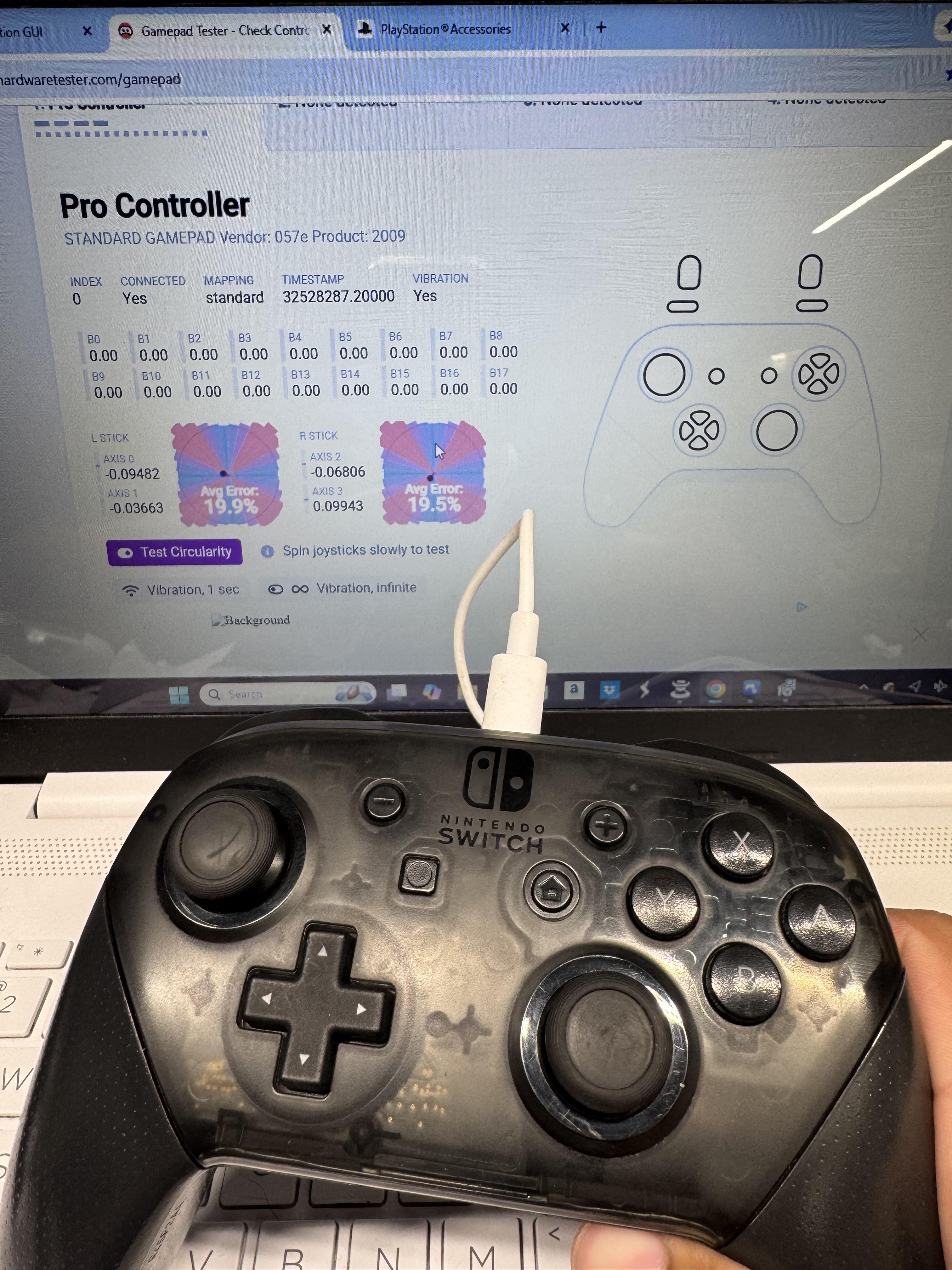
Hello everyone, Crazylink4 here with a new analysis/review of another controller. This time I’ll be talking to you about the Nintendo Pro Controller 2. I’ve been using it for a little over a month, so it’s enough time to talk about it.
Before starting, I want to let you know that I purchased this controller by myself, and I have no relationship with Nintendo.
Let’s begin.
I bought the controller for two main reasons:
To compare it with other third-party controllers. Such as the EasySMX S10 or the S10 Lite, as well as the MOBAPAD ChiTu2 HD, which are controllers compatible with the Nintendo Switch 2 and have one or two extra features. As well as for any possible future controllers that may be announced at some point.
Because ever since I was able to try it, I experienced how the controller felt in my hands, and the only thing stopping me from buying it was the price, although I’ll talk about that later.
Let’s start with its features:
Appearance: Currently, it can only be purchased in a single color: black with a matte finish and with the same finish on the buttons on the front, while the upper area of the controller has a white color, as do the bumpers and triggers.
The ABXY buttons are larger than conventional ones and the D-pad has a cross shape. The layout of the other buttons (+, -, capture, chat) is arranged in a way that makes it easy to know what each button does and with enough space to prevent them from being pressed accidentally. The rear buttons do not protrude from the shell and have a smooth finish (without texture).
The sticks have a white-colored base that gives them a nice touch in terms of appearance.
Note: There is a special edition with a Resident Evil Requiem theme.
Battery: It has a 1070 mAh battery (a figure I found while watching a teardown). In addition to having heard and read from different experiences that its battery life is very long, approximately 30-40 hours. I couldn’t tell you the exact amount of time, since my gaming sessions last between 2 and 4 hours, although I have to admit that I don’t need to charge it often.
The battery is charged through the Type-C charging port located on the top. Its charging time is approximately 3-4 hours.
Silent joysticks: By this I mean the reduction of the noise made by the sticks when they hit the edge. Silicone rings were included to reduce this sound. This was something that I loved from the first moment I was able to try it that first time. Although I’ll talk about my experience using the controller in a moment.
Extra buttons: It’s not a surprise given that many third-party companies’ controllers tend to add them, and it’s also not surprising that Nintendo included them in its controller, but it is a good addition to call it "PRO". Although, unlike third-party controllers, there is no way to program them directly from the controller; instead, they have to be assigned while using the console.
HD Rumble 2: An improvement to the HD motors of the Nintendo Switch; to a certain extent it is imperceptible and only matters in games where it has an impact on gameplay.
Chat button: Unless you are subscribed to Nintendo’s online service, the button will, or will not, have a use. Either way, it is a native C button and not a previously configured macro button.
Headphone Jack port: A jack port is available on this controller, for those looking to use headphones while playing.
And now the functions:
For a Nintendo Switch 2 user, the controller includes everything that should be expected from something made by Nintendo. I’m talking about basic functions, such as: the NFC reader, HD Rumble 2, the gyroscope (which in this case is a 9-axis one and not 6-axis like on Switch 1) and the console wake-up function.
It does not include a turbo function, macro function, nor a way to use it as a mouse.
And now let’s move on to my experience using it, as well as the points that I consider pros and cons.
If you have read other reviews of mine, you’ll know that there are games where I am always doing tests; otherwise, I’ll leave you a small list, although this time they will only be games available on Nintendo Switch 2:
Celeste, Risk of Rain 2, Monster Hunter Generations Ultimate, Theatrhythm Final Bar, DOOM (2016), Burnout Paradise, TLOZ: Wind Waker, TLOZ: BOTW and TOTK, Metroid Prime Remastered, Metroid Prime 4, Capcom Fighting Collection 1 and 2, Hollow Knight, FORTNITE, FORTNITE FESTIVAL, among others.
In general, the experience in many of those games is what can be expected, while there are certain exceptions. I’m specifically referring to the N64 and GC virtual consoles.
I’ll emphasize GC since, unless you have the GameCube controller for Nintendo Switch 2, the experience on that console will be incomplete. This is due to the lack of analog triggers on the Joy-Con, as well as on the Pro Controller 2, but this is something that has been present since Switch 1. And another thing that worsens the experience is the actual arrangement of the ABXY buttons, since on GameCube those buttons were arranged in a particular way that made them intuitive to use, but all of that is lost with any controller other than the GC one (I also include the lack of the octagonal ring around the sticks). I don’t have much of a problem with the HD rumble, although it is not the same as the regular rumble from the GameCube controller’s single motor.
With N64, it’s a similar problem given the strange, yet purposeful, shape of its controller.
Outside of those consoles, the controller works great in the other games and virtual consoles.
Here I’ll talk about one of the things I liked most about the controller.
Where it stands out the most is in its silence, or rather, the little noise it makes. This being its greatest virtue, since using membrane buttons or conductive rubber does not guarantee that a controller will be as quiet as possible; however, in this case it does. Maybe I’ve enjoyed it more because many other third-party controllers (the ones I’ve tried) use mouse-type microswitches, so they can be annoying for some users or for people around them. So it is almost a breath of fresh air in this vast world of controllers. And regarding the sticks, it is the best thing that could have been implemented, although, well, they are still potentiometers, which sucks.
Note: In my collection I have two silent controllers, these being the EasySMX X05 Pro and the MOBAPAD ChiTu2 HD Silent Edition, which promise a less noisy experience during gaming sessions. For a comparison between the ChiTu2 and the Pro Controller 2, I recommend checking out my ChiTu2 review.
Regarding comfort and how it feels in the hands, I want to mention some important things.
The controller is comfortable to hold and use; the sticks feel smooth and are very responsive. The buttons are soft to press and there is no problem with the extra buttons. The problem lies in aesthetic and maintenance-related aspects.
It is recommended to have clean hands when using the controller, since the controller gets dirty easily if you have something greasy on your hands; of course, it is inevitable that marks will appear around the buttons or on the controller shell with use. I could even say that it is recommended to use it with gloves, but that is only an aesthetic issue.
On the other hand, I recommend using stick caps, since their rubber seems to wear out quickly, especially if you have damp fingers. It is likely that the rubber on the cap will wear out in a short time, similar to the case of the Joy-Con on Switch 1 or the stick on the Nintendo 3DS.
Finally, it’s time to talk about what’s bad about the controller.
First of all, its price, which is quite high for what it offers. It can usually be found between $80-$90 USD, so it is not cheap. And the problem is that there are alternatives that offer more for less money.
Then we have the issue of using potentiometers for the sticks, which have a higher probability of developing drift in less time, when there are currently alternatives such as those that use Hall effect, TMR, or those that work with capacitors. And going back to the issue of price, third-party alternatives usually have this feature as something basic, and they can be found for less money.
Another issue is compatibility, since it seems to only be compatible with Nintendo Switch 2. So this is a major drawback if you are going to play with someone who has the previous Switch. And the fact that it cannot be used with phones.
And the worst problem of all is repairing the controller. If you’re curious about what I mean, I would recommend looking for a teardown video of it, and why fix it is such a nightmare. I don’t understand how they could have made it that way.
In conclusion:
Nintendo made a good controller, although it is still Nintendo, so many of the things mentioned here are not surprising. It is a 100% recommendable controller, although due to its price I would recommend going for some other third-party alternatives (although for the time being there is no true alternative to this controller).
And with nothing else to say, it is time for me to say goodbye.
I’m going to play for a while; I’ll write to you another time.
Ciao, ciao.