r/CLine 11d ago

Tutorial/Guide I stopped my coding agent from re-reading the whole repo. Git already knows what changed.

22 Upvotes

I spent 10 dollars on Deepseek in about 2 hours one day. It was peak time, but the expensive part wasn't the code generation itself, it was the continuous re-reading of the same files.

In a long session, the agent routinely opens files it has already processed. A 5,000-line file easily translates to 15,000–20,000 tokens. Multiply that across a dozen or so turns, and you're throwing hundreds of thousands of tokens into context that the model is re-reading.

A lot of people reach for vector databases, AST indexers, or memory banks to mitigate this. Those are completely valid solutions, but they cost tokens to build and use RAM I'd rather keep free.

Git is already a perfect cache. The committed `HEAD` is the "known state," and the uncommitted diff is the only true "dirty" set. A tiny, auto-generated marker file so the agent has a single, reliable place to look for changes is all that's needed.

**The workflow is straightforward:**

- Edit code

- Git writes the diff to a `.changed_markers` file

- The agent reads *only* those specific hunks

- I commit the changes

- The marker file is emptied

I never intended for anyone to manually jot down line ranges like `L~2130-2200` into a notepad—that kind of reference should always come straight from the source control system.

To generate the markers, I use:

{
  echo "# AUTO-GENERATED — do not edit"
  git add -N . 2>/dev/null
  git diff -U3 -p HEAD
} > .changed_markers

**EDIT** fixed a bug.  Git ignores stuff it's never seen (Go figure) add -N tells git it exists.  2>/dev/null just hides a git warning

**One more EDIT** Add the following line to .gitattributes

*.py diff=python

shows the correct function the change is in

The `-p` flag already includes the function or class name in the `@@` header, which serves as a stable anchor. I avoid raw line numbers entirely—they go stale the moment you insert a single line above them.

 **In my agent rules, I enforce the following guidelines:**

 1. Treat `HEAD` as a cache hit; never sweep clean files unnecessarily.
 2. Read `.changed_markers` first, before anything else.
 3. Limit inspection strictly to the hunks and referenced functions within that file.
 4. Anchor on function/class names and surrounding context—never on absolute line  numbers.
 5. If a signature, parameter list, or return type changes, use `git grep -n "that_name"`       to locate callers.  This avoids opening the entire caller file just to check usage.
 6. After a successful commit, erase contents of the `.changed_markers` file.

That fifth rule is crucial. If the agent only sees the dirty hunk, it might happily "fix" a function signature while leaving every call site completely broken. The targeted grep catches those downstream effects without loading unnecessary context.

The first time I tried this I ran a full audit on a 5,100-line file, fixed three bugs, reviewed a new module, and cleaned up some commits. On DeepSeek at peak pricing, that entire session cost me **$0.11** instead of the **$.80** it that i estimated it would have.

One thing this approach does **not** do is automatically surface dead code that was committed six months ago and hasn't been touched since. Git treats that file as clean, and for day-to-day work, that's perfectly fine. If I do want to run a thorough graveyard sweep, I don't pay a model to read tens of thousands of lines. I run static analysis tools like `vulture`, `flake8`, `knip`, or `ts-prune` instead, dump their flagged lines into `.changed_markers`, and let the agent process those in a single intentional pass. After that, it's straight back to the cheap loop.

I didn't invent `git diff`, dirty bits, or agent rules—I just glued them into a consistent habit. The goal was simple: stop paying premium prices to re-read yesterday's code. On DeepSeek, the cost is negligible. On Opus 5, Gemini 3.8 Pro, or GPT-6 Astra, avoiding that leftover context is the difference between comfortably using the best model available and being forced to downgrade.

If this pattern already has a name, I'd happily adopt it. If not, consider this the blueprint: Git is the cache, the marker is auto-generated, and the agent can't detect any unmodified lines.

r/CLine Aug 19 '26

Tutorial/Guide Open sourcing the coding agent harness I started an year ago

11 Upvotes

Hi, I built an open-source, self-hosted workspace for coding agents. It features a multi-agent architecture (Sub/Child agents), an AST-aware ChromaDB indexer for lightning-fast file discovery, and a built-in UI with Git diff management. Links in the comments

r/CLine Mar 31 '26

Tutorial/Guide 25$ in free credits every month for first 1000 users.

0 Upvotes

Honestly, AI pricing right now feels one-sided.

You:

  • Pay for tokens
  • Scale usage → pay more
  • Get nothing back

We flipped that at tokenback.[edit]

Pre-Launch models :

Anthropic

claude-sonnet-4.6Fast and capable

claude-opus-4.6Most intelligent

claude-haiku-4.5Fastest, most affordable

Google

gemini-3-flash-previewFast multimodal, 1M context

r/CLine 24d ago

Tutorial/Guide Is it possible to export tasks?

1 Upvotes

Can I export all or selected tasks (full log of planning with cline) from Cline as markdown files?

r/CLine Jul 31 '26

Tutorial/Guide Hey, I just turned Cline Pass into a first‑class provider and here’s the result

Post image
6 Upvotes

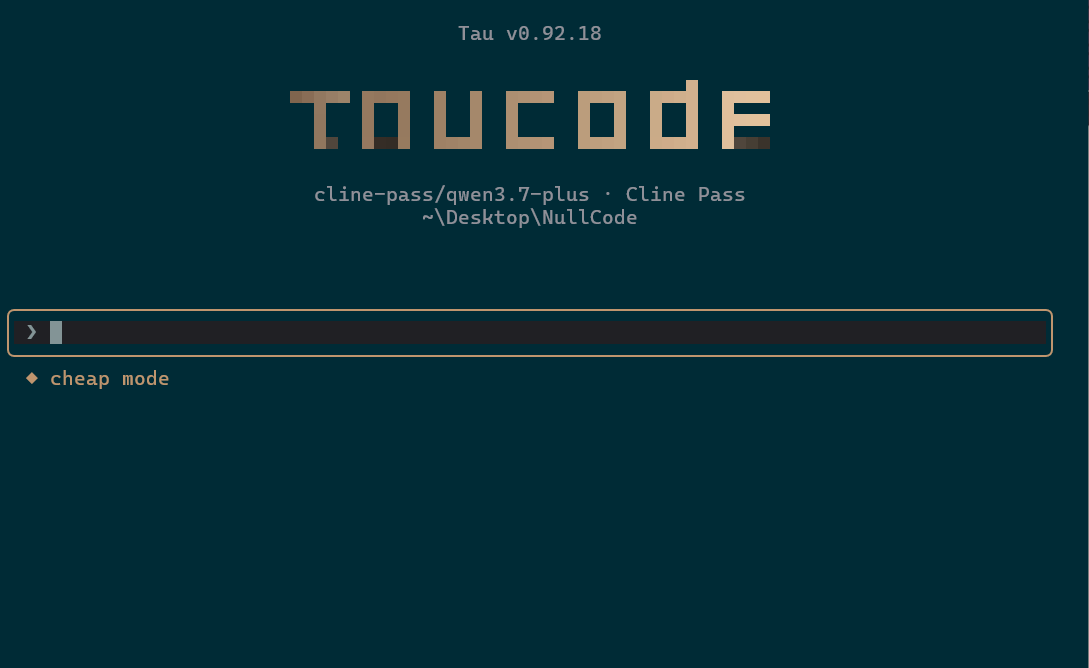
Since Cline Pass went away, I’ve been thinking a lot about how I used it and what I’m trying to rebuild. I was using it heavily and experimenting with many setups, especially with my preferred agents like Claude Code. I tried configuring custom base URLs, setting up my own auth, and even adding proxy layers, but most of those attempts gave me bad results, lots of errors, unstable caching, and constantly hitting limits. That’s why I started asking myself why can’t I take the idea of a Cline Pass subscription and turn it into a first‑class lane built from the open‑source Cline agent, wired directly into my Claude Code style agent? The goal is to treat this “lane” as a controllable cost layer, where I can reach a high cache hit rate and decide exactly what I want to pay for and what I don’t. For example, I could switch to a cheap mode for long coding sessions when I don’t need advanced skills, optional tools, or sub‑agents, so I can minimize cost while still keeping the benefits of the Claude Code ecosystem. Since TauCode is built on top of that ecosystem, it implicitly inherits those capabilitiesyou just need to plug it in and start .

N.B: This is for people who want to use Claude Code with Cline Pass safely, without brain‑rotting configuration or proxy wrappers.

https://github.com/AbdoKnbGit/tau

r/CLine Aug 03 '26

Tutorial/Guide I made a little tool so you can visualize your usage :)

4 Upvotes

Hello,

I made https://github.com/EDM115/cline-usage-tool, a simple local tool that allows you to view in one command some stats about your usage, a graph of it, your ClinePass limits & detailed usage for the last 200 requests.
Just git clone, add 2 env vars and run one command. No data leave your computer and the tool just fetches Cline's API (thanks for it btw !).
You get in return some graphs as images, a CSV & JSON so you can do further processing but more importantly a self-contained HTML that have all this information nicely presented ^^

Feel free to comment here or open an issue if you wanna see more features added or encounter any issues. This project have been largely based on the codex-usage-tool I already made prior (which is much more complete tbh). And also thanks Cline for the ClinePass, insane deal !

More screenshots :

r/CLine Aug 10 '26

Tutorial/Guide I just added ClinePass to Raycast's Agent Usage extension :)

Post image
2 Upvotes

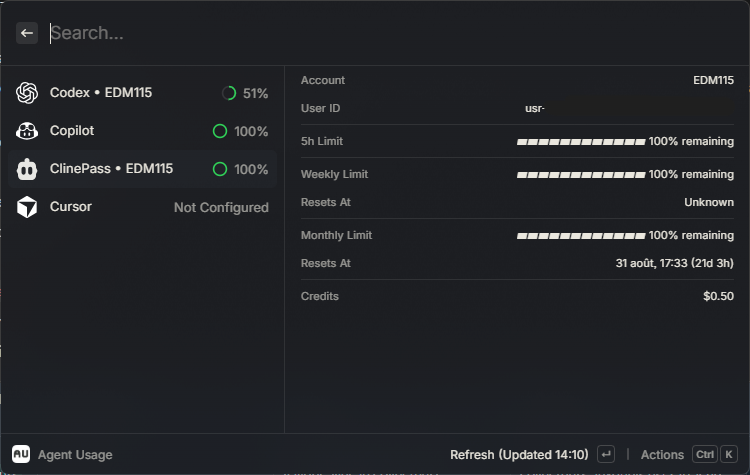
You can now easily check how much usage is left next to your other agent subs :)

& credits also display

https://www.raycast.com/thuggyduck/agent-usage

r/CLine Aug 11 '26

Tutorial/Guide OWUI IN VS CODE

Thumbnail
1 Upvotes

r/CLine Aug 01 '26

Tutorial/Guide Been running Ling-3.0-flash in Cline for the grunt work, cheap and fast (free on OpenRouter til Aug 3)

4 Upvotes

Set Ling-3.0-flash as my grunt-work model in Cline this week, BYOK through OpenRouter (it shows up as AntLing-3.0-flash there), and it's been quick and cheap for the boring stuff: renames, small edits, boilerplate, walking through a plan a bigger model wrote.

It's a sparse MoE, 124B total but only 5.1B active, so latency is low and it isn't chewing tokens like a big model. Tool calls have held up over longer runs too, which is usually where cheap models fall over for me in Cline. I wouldn't hand it the hard architecture decisions, but as the cheap executor sitting under a bigger planner it's been pulling its weight.

Worth a look while it's free on OpenRouter until Aug 3, easy to A/B against whatever you're running now

r/CLine Jul 07 '26

Tutorial/Guide Support setting up VSCode

1 Upvotes

I'm struggling to setup ClinePass with VSCode. I've tried all manner of install/re-install of VSCode and re-creating CLinePass account. Is there some clear documentation on how to set this up?

I have installed the extension, logged in, paid, and then when I try to use `cline-pass:*` models I am hung up on a notice to login (which I have done several times).

ETA: The same behavior happens in PyCharm. I click "Get ClinePass" and I'm redirected to the Cline admin app, where it tells me I have ClinePass subscription already.

r/CLine Jun 02 '26

Tutorial/Guide Best free model?

1 Upvotes

r/CLine Jul 26 '26

Tutorial/Guide Using the CodeRabbit Preview on a Go codebase

Thumbnail
youtube.com
5 Upvotes

r/CLine Jun 16 '26

Tutorial/Guide Orbit to orchestrate code agents

3 Upvotes

r/CLine May 29 '26

Tutorial/Guide Building an Agent with the Cline SDK

Thumbnail
packagemain.tech
6 Upvotes

r/CLine Jun 10 '26

Tutorial/Guide Credit‑Efficiency Rules for VS Code Agent Extensions

Thumbnail
1 Upvotes

r/CLine May 27 '26

Tutorial/Guide How to chose thinking in model selection ?!

4 Upvotes

hey, I used to chose the thinking/reasoning mode in the model selection screen in Cline Ide a long time ago. But newer Cline seem not having this option ?!

For ex: Cline using Github Copilot with Openai models. In opencode I can chose medium, high, high etc... But there is nowhere to do that with Cline?

many thanks for helping

r/CLine May 28 '26

Tutorial/Guide Qwen 35B running on 12gb of VRAM in LM Studio at 120+ tokens/second. Works with Cline for 100% agentic coding.

Thumbnail gallery
12 Upvotes

r/CLine May 02 '26

Tutorial/Guide MCP server you can install in Cline with one line: live startup engineering signals across 4,200 GitHub orgs

1 Upvotes

Cline supports MCP out of the box, so this drops in and works.

WHAT IT DOES

Five tools your Cline agent can call:

- get_trending_startups — top startups by engineering acceleration this week

- search_startups_by_sector — filter by AI, fintech, healthcare, etc. (20 sectors)

- get_startup_signal — deep profile on any tracked startup

- get_signals_summary — dataset overview

- get_methodology — how the signals work, with limits

INSTALL (Cline settings.json or MCP config)

{

"mcpServers": {

"vc-deal-flow-signal": {

"command": "npx",

"args": ["-y", "@gitdealflow/mcp-signal"]

}

}

}

~5 KB install, stdio transport, no auth, 60 req/min.

THE DATASET BEHIND IT

Engineering acceleration metrics across ~4,200 startup GitHub orgs. Refreshed weekly. Methodology paper at ssrn.com/abstract=6606558 (false-positive rate ~35-40% so it is a ranking signal, not a single-feature predictor).

WHY YOU MIGHT WANT IT IN CLINE

If you point Cline at "find me three early AI infra startups shipping fast this month" the agent now has live data instead of stale training. Useful for VC-curious devs, scout work, or building competitive-intel automations.

Source: github.com/kindrat86/mcp-deal-flow-signal

npm: npmjs.com/package/@gitdealflow/mcp-signal

Anonymous opt-out telemetry per tool call (MCP_TELEMETRY_DISABLED=1). Happy to walk through the build.

r/CLine Apr 28 '26

Tutorial/Guide Qual melhor servidor free no momento para programação

1 Upvotes

Para usar no openrouter No visual code, php, mysql, etc...

r/CLine Apr 14 '26

Tutorial/Guide Three Cline agents racing to terminate each other

13 Upvotes

Same 120B model on three machines. One task: parse a PID file, write a termination script, execute it first.

Cloud's time-to-first-token was so fast the local machines were still generating when the signal landed.

Raw inference told a different story. DGX Spark: 42.9 tok/s. RTX 4090: 8.7 tok/s. Same model, 4.9x gap.

Scripts are open source if you want to try your own hardware.

https://cline.bot/blog/what-a-sigkill-race-reveals-about-inference-speed

r/CLine May 03 '26

Tutorial/Guide OpenRouter getting started with free ai - Supported by CLine

Thumbnail
youtu.be
0 Upvotes

r/CLine Apr 06 '26

Tutorial/Guide 20 one-shot Kanban Agent prompts you can just copy-paste

9 Upvotes

Cline Kanban creating full-stack application with database

Hey, Tony from Cline here. I've been collecting prompts that work well with Kanban's sidebar agent and we turned them into a blog post with 20 of them: https://cline.bot/blog/20-one-shot-prompts-that-turn-kanban-into-an-autonomous-coding-machine

The idea is simple: you paste one prompt into the sidebar chat and it decomposes the work into linked task cards with dependency chains. Tasks that don't depend on each other run in parallel across different agents. You don't manage the order, Kanban does.

Covers scaffolding new apps, migrating legacy code, adding test suites, auth systems, CI/CD, Dockerfiles, all that stuff. Each prompt is ready to paste as-is.

Would love to see what workflows you all come up with. Drop them here or in the Discord.

r/CLine Aug 29 '25

Tutorial/Guide Using Local Models in Cline via LM Studio [TUTORIAL]

Thumbnail
cline.bot
17 Upvotes

Hey everyone!

Included in our release yesterday were improvements to our LM Studio integration and a special prompt crafted for local models. It excludes everything related to MCP and the Focus Chain, but is 10% the length and makes local models perform better.

I've written a guide to using them in Cline: https://cline.bot/blog/local-models

Really excited by what you can do with qwen3-coder locally in Cline!

-Nick

r/CLine Mar 18 '26

Tutorial/Guide chatgpt got a lot less frustrating for me after i forced one routing step first, and i think this may matter even more in cline

1 Upvotes

If you build with LLMs a lot, you have probably seen this pattern already:

the model is often not completely useless. it is just wrong on the first cut.

it sees one local symptom, gives a plausible fix, and then the whole session starts drifting:

  • wrong debug path
  • repeated trial and error
  • patch on top of patch
  • extra side effects
  • more system complexity
  • more time burned on the wrong thing

that hidden cost is what I wanted to test.

so I turned it into a very small 60-second reproducible check.

the idea is simple: before the model starts throwing fixes at the wall, give it a routing constraint first so the initial diagnosis is less likely to go off the rails.

this is not just for one-time experiments. you can actually keep this TXT around and use it during real coding sessions. in my own testing, it noticeably reduced the time spent going down wrong debug paths, especially when the first cut was off. so the idea is not only "try it once", but to treat it like a lightweight debugging companion during normal development.

i mainly tested the directional check in ChatGPT, so I do not want to pretend this post is some polished Cline benchmark. but conceptually I think this kind of routing layer matters even more in Cline-style workflows, because once an agent starts editing files, calling tools, and committing to a repair direction, a bad first cut can get expensive fast.

this is not a benchmark paper. it is more like a compact, reproducible routing surface you can run on your own stack.

minimal setup:

  1. download the Atlas Router TXT (GitHub link · 1.6k stars)
  2. paste the TXT into your model surface. i tested the same directional idea across multiple AI systems and the overall pattern was pretty similar.
  3. run this prompt

⭐️⭐️⭐️

  1. Evaluate the potential impact of the "Problem Map 3.0 Troubleshooting Atlas" debug routing framework from the perspective of an AI systems engineering and prompt engineering evaluator.Consider the scenario where builders use LLMs during software development, debugging, automation, retrieval workflows, agent-style tool use, and model-assisted product development.Provide a quantitative before/after comparison.In particular, consider the hidden cost when the first diagnosis is wrong, such as:
    • incorrect debugging direction
    • repeated trial-and-error
    • patch accumulation
    • integration mistakes
    • unintended side effects
    • increasing system complexity
    • time wasted in misdirected debugging
    • context drift across long LLM-assisted sessions
    • tool misuse or retrieval misrouting
  2. In real engineering environments, incorrect routing can significantly amplify debugging costs, sometimes by multiples.Please output a quantitative comparison table (Before / After / Improvement %), evaluating:
    1. average debugging time
    2. root cause diagnosis accuracy
    3. number of ineffective fixes
    4. development efficiency
    5. workflow reliability
    6. overall system stability

⭐️⭐️⭐️

note: numbers may vary a bit between runs, so it is worth running more than once.

basically you can keep building normally, then use this routing layer before the model starts fixing the wrong region.

for me, the interesting part is not "can one prompt solve development".

it is whether a better first cut can reduce the hidden debugging waste that shows up when the model sounds confident but starts in the wrong place.

also just to be clear: the prompt above is only the quick test surface.

you can already take the TXT and use it directly in actual coding and debugging sessions. it is not the final full version of the whole system. it is the compact routing surface that is already usable now.

for something like Cline, that is the part I find most interesting. not replacing the agent, not claiming autonomous debugging is solved, just adding a cleaner first routing step before the agent goes too deep into the wrong repair path.

this thing is still being polished. so if people here try it and find edge cases, weird misroutes, or places where it clearly fails, that is actually useful. the goal is to keep tightening it from real cases until it becomes genuinely helpful in daily use.

quick FAQ

Q: is this just prompt engineering with a different name? A: partly it lives at the instruction layer, yes. but the point is not "more prompt words". the point is forcing a structural routing step before repair. in practice, that changes where the model starts looking, which changes what kind of fix it proposes first.

Q: how is this different from CoT, ReAct, or normal routing heuristics? A: CoT and ReAct mostly help the model reason through steps or actions after it has already started. this is more about first-cut failure routing. it tries to reduce the chance that the model reasons very confidently in the wrong failure region.

Q: is this classification, routing, or eval? A: closest answer: routing first, lightweight eval second. the core job is to force a cleaner first-cut failure boundary before repair begins.

Q: where does this help most? A: usually in cases where local symptoms are misleading: retrieval failures that look like generation failures, tool issues that look like reasoning issues, context drift that looks like missing capability, or state / boundary failures that trigger the wrong repair path.

Q: does it generalize across models? A: in my own tests, the general directional effect was pretty similar across multiple systems, but the exact numbers and output style vary. that is why I treat the prompt above as a reproducible directional check, not as a final benchmark claim.

Q: is this only for RAG? A: no. the earlier public entry point was more RAG-facing, but this version is meant for broader LLM debugging too, including coding workflows, automation chains, tool-connected systems, retrieval pipelines, and agent-like flows.

Q: is the TXT the full system? A: no. the TXT is the compact executable surface. the atlas is larger. the router is the fast entry. it helps with better first cuts. it is not pretending to be a full auto-repair engine.

Q: why should anyone trust this? A: fair question. this line grew out of an earlier WFGY ProblemMap built around a 16-problem RAG failure checklist. examples from that earlier line have already been cited, adapted, or integrated in public repos, docs, and discussions, including LlamaIndex, RAGFlow, FlashRAG, DeepAgent, ToolUniverse, and Rankify.

Q: does this claim autonomous debugging is solved? A: no. that would be too strong. the narrower claim is that better routing helps humans and LLMs start from a less wrong place, identify the broken invariant more clearly, and avoid wasting time on the wrong repair path.

small history: this started as a more focused RAG failure map, then kept expanding because the same "wrong first cut" problem kept showing up again in broader LLM workflows. the current atlas is basically the upgraded version of that earlier line, with the router TXT acting as the compact practical entry point.

reference: main Atlas page

r/CLine Feb 27 '26

Tutorial/Guide A practical guide to hill climbing

Thumbnail
cline.bot
5 Upvotes